Arthevas: Modern Calligraphy That Feels Human
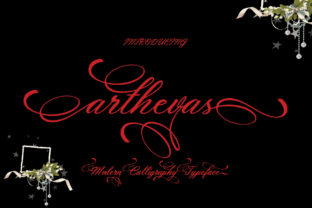
If you’ve ever spent minutes tweaking letter spacing in a logo, agonized over whether a wedding invitation feels “just right,” or scrapped three versions of a newsletter header because none captured warmth and professionalism at once—you’re not overthinking. You’re responding to something real: the growing need for type that communicates personality without sacrificing polish. Arthevas meets that need precisely. It’s not just another script font—it’s a modern calligraphy typeface built with intention: expressive swashes, graceful grounds, and fine-line precision that reads as hand-drawn but performs like a professional tool.
Why Handwritten Authenticity Still Matters—Especially Now
In an age of AI-generated content and templated designs, audiences respond more deeply to visual cues that signal care, individuality, and human presence. A signature on a client contract, a name on a wedding suite, or even the “Thank You” line in a small-business email—all carry subtle weight. Arthevas delivers that weight thoughtfully. Its swashes aren’t decorative afterthoughts; they’re balanced, purposeful flourishes that guide the eye without overwhelming it. The grounds—the underlying structure of each character—are generous and stable, giving text breathing room and legibility even at smaller sizes. And those fine lines? They lend elegance without fragility, making Arthevas work equally well on matte paper stock or high-resolution digital signage.
Where Arthevas Fits—and Where It Shines Brightest
Arthevas excels where tone and identity intersect. Consider these real-world scenarios:
- Small business owners using it for letterheads or product labels gain instant differentiation—no need for complex illustrations when the typography itself conveys craftsmanship and approachability.
- Wedding designers and stationers rely on fonts that feel personal yet refined. Arthevas handles names, dates, and quotes with equal grace, and its swash variants let couples add subtle uniqueness to monograms or envelope addressing.
- Educators and nonprofit communicators often need materials that feel warm and trustworthy—not corporate or cold. A poster announcing a community workshop or a donor newsletter benefits from Arthevas’ sincerity without sacrificing clarity.
- Freelance designers and marketers appreciate how quickly Arthevas elevates mockups. Pairing it with a clean sans-serif (like Inter or Manrope) creates immediate visual hierarchy—no trial-and-error needed for title + body balance.
It’s also unusually versatile across formats. Unlike some calligraphy fonts that blur at small sizes or collapse in all-caps settings, Arthevas maintains integrity from 14pt body text in a newsletter to 120pt signage. That consistency saves time—fewer font swaps, fewer readability checks, less revision.
Practical Tips for Getting the Most From Arthevas
Like any expressive typeface, Arthevas works best when paired intentionally—not just stylistically, but functionally.
Start with contrast. Use Arthevas for headlines, names, or short phrases where its character can breathe. Then choose a neutral, highly legible sans-serif for supporting text. Avoid pairing it with other scripts or overly decorative fonts—that dilutes its impact and risks visual noise.
Leverage its OpenType features if your software supports them. Many versions include alternate characters, contextual swashes, and ligatures that activate automatically or via manual selection. A single click can transform “Emma & James” into a flowing, connected phrase with elegant entry and exit strokes—ideal for invitations or social media banners.
For print projects, test color contrast early. Because of its fine lines, Arthevas performs best against solid, light-to-mid-tone backgrounds. Deep navy or charcoal works beautifully; pure black on white is crisp, but avoid very thin weights on textured paper unless you’re confident in your printer’s resolution.
Who Might Want to Look Elsewhere?
Arthevas isn’t designed for dense editorial layouts, long-form web copy, or interfaces requiring rapid scanning. If your primary need is a versatile, all-in-one font family for UI design, technical documentation, or multilingual publishing, a robust serif or variable sans-serif would be more appropriate.
Also, while its swashes are magnificent, they’re not meant for every word. Overusing them—especially in logos or branding systems—can reduce recognizability over time. A strong brand mark often relies on simplicity and repetition; reserve swashes for moments of emphasis or emotional punctuation.
And though Arthevas includes standard Latin characters and common punctuation, verify glyph coverage if you’re working with accented characters beyond Western European languages. Some users report limited support for extended diacritics or non-Latin scripts—so always check the character map before committing to large-scale multilingual use.
Real Creativity Starts With the Right Tools—Not Just the Flashiest Ones
Choosing a font isn’t about trend-chasing. It’s about selecting a tool that aligns with your goals, audience expectations, and execution reality. Arthevas stands out because it bridges two often-competing needs: authenticity and reliability. It feels handmade—but it’s engineered for consistency. It’s decorative—but never at the expense of function.
That balance matters most when stakes are personal or professional: the first impression of your freelance portfolio site, the tone of a heartfelt client thank-you note, the visual cohesion of a boutique’s packaging system. In those moments, Arthevas doesn’t just look good—it helps you communicate more fully, with less friction.
Think of it this way: you wouldn’t choose a chisel for sanding wood, nor a sander for carving detail. Arthevas is the chisel—the precise, expressive instrument for moments where nuance carries meaning. Used with awareness and restraint, it deepens connection, strengthens voice, and quietly elevates everyday communication.
A Final Thought for Designers and Non-Designers Alike
You don’t need formal training to benefit from thoughtful typography. Whether you’re building a Canva template for your yoga studio, drafting a heartfelt email to donors, or designing a custom badge for a conference—Arthevas offers an accessible path to more resonant visuals. Its learning curve is shallow, its payoff immediate. And because it’s rooted in real calligraphic principles—not algorithmic mimicry—it ages well. A logo set in Arthevas today won’t look dated in five years the way some trend-driven scripts do.
So if your current go-to script feels either too stiff or too chaotic—if you’ve ever hesitated before hitting “send” on a design because something felt *off*—give Arthevas space to breathe in your next project. Not as a gimmick, but as a considered choice. One that says, without words: This was made with care.