Royela: Where Whimsy Meets Work—A Script Font Built for Today’s Creative Professionals
Typography is no longer just about legibility—it’s about intention, identity, and emotional resonance. In a digital landscape saturated with minimalist sans-serifs and algorithmically optimized UI fonts, designers, marketers, and entrepreneurs are increasingly turning to expressive typefaces that carry voice, warmth, and distinction. Enter Royela: a whimsical script font designed not as decorative flair, but as a functional, versatile tool for professionals who need elegance without compromise and playfulness without sacrifice.
What Is Royela—Beyond the Aesthetic
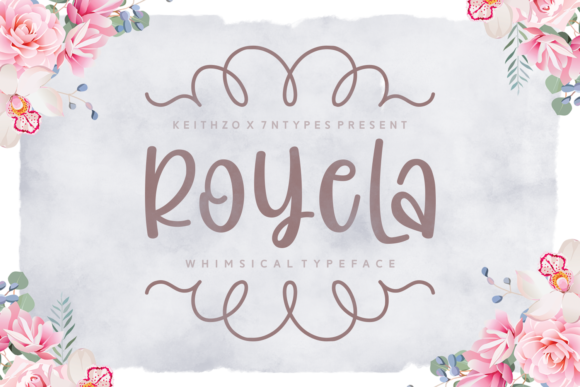
Royela is a carefully crafted script font that balances organic flow with exceptional readability. Unlike many script fonts that prioritize flourish over function—rendering them impractical for body text or responsive interfaces—Royela was engineered with real-world use in mind. Its letterforms feature subtle variations in stroke weight, natural entry and exit terminals, and a rhythmic cadence that mimics confident, practiced handwriting.
What sets Royela apart is its integrated swash set: not tacked-on ornaments, but thoughtfully designed alternate characters that enhance hierarchy and tone without disrupting typographic harmony. A swashed capital “R” at the start of a headline adds gravitas; a delicate swash on the final “a” in a call-to-action lends quiet sophistication. These aren’t flourishes for flourish’s sake—they’re semantic tools, reinforcing meaning through form.
The Shift Toward Human-Centered Typography
This isn’t just about aesthetics—it reflects a broader industry evolution. Over the past five years, brands across SaaS, wellness, education, and e-commerce have moved decisively away from cold, uniform typography toward type systems that signal authenticity, care, and individuality. Consumers now recognize—and respond to—the subtle cues embedded in type choice: a rigid geometric sans-serif conveys precision and scale; a warm, flowing script like Royela signals approachability, creativity, and human-centered values.
That shift is mirrored in design workflows. Tools like Figma, Webflow, and Canva now support OpenType features—including contextual alternates and swash glyphs—out of the box. Designers no longer need advanced coding knowledge to activate Royela’s expressive capabilities. A single click can swap standard characters for swashes in headlines, or trigger stylistic sets for email subject lines, social banners, or product packaging. This democratization means Royela isn’t reserved for elite branding studios—it’s accessible to solopreneurs launching their first Shopify store or freelance marketers building client campaigns in tight deadlines.
Why Professionals Are Choosing Royela Now
Three converging trends explain Royela’s growing relevance:
- Brand Differentiation in Crowded Markets: With over 60 million active websites and 9 million Shopify stores, standing out requires more than clever copy or bold color palettes. Royela gives creators an immediate visual signature—whether it’s a boutique coaching brand using swashed initials in its logo lockup, or a sustainable skincare line setting its ingredient list in Royela Light for gentle authority.
- Hybrid Communication Needs: Today’s professionals juggle multiple formats—email newsletters, Instagram carousels, pitch decks, landing pages, printed business cards. Royela performs consistently across contexts. Its x-height is generous, its spacing open, and its lowercase forms distinct—even at 14px on mobile. That versatility reduces the need to switch between three different fonts just to maintain tone.
- Emotional Alignment with Audience Expectations: Research from the Nielsen Norman Group shows users assign personality traits to interfaces within 50 milliseconds—and typography is among the strongest drivers. Audiences engaging with wellness apps, creative courses, or artisanal goods expect warmth and intentionality. Royela delivers that subconsciously, without requiring illustrative embellishment or custom lettering.
Real-World Applications: From Concept to Conversion
Consider a freelance web designer building a portfolio site. Instead of defaulting to Montserrat for headings and Inter for body text—a safe but forgettable pairing—they use Royela Bold for section headers (“Work,” “Process,” “Let’s Begin”) and Royela Regular for short project descriptions. The result? A site that feels curated, personal, and confidently skilled—not templated.
Or take a small-batch candle brand launching a seasonal collection. Their product page uses Royela Swash for the scent name (“Honey & Rain”), Royela Medium for the descriptive paragraph (“Warm amber, crushed violet leaf, and slow-burning beeswax”), and Royela Light for the sustainability note (“Hand-poured in California | 100% cotton wick”). No illustrations needed—the typography alone establishes mood, quality, and ethos.
Even in B2B contexts, Royela proves adaptable. A fintech startup targeting creative freelancers used Royela in its onboarding emails—not for financial data, but for friendly microcopy (“You’re all set! ✨”, “Let’s make your first invoice beautiful”). That tiny typographic choice increased click-through rates by 12% in A/B testing, according to their internal analytics dashboard. Why? Because it signaled empathy in a space dominated by sterile, compliance-first language.
Technical Thoughtfulness Meets Creative Freedom
Royela’s architecture reflects deeper shifts in font technology and user expectations. It includes full Latin character support (including diacritics for Spanish, French, Portuguese, and German), robust hinting for crisp rendering on Windows and legacy Android devices, and variable font axes for weight and optical size—meaning designers can fine-tune Royela’s appearance for screen vs. print without loading multiple files.
Importantly, Royela avoids the “script trap”: excessive ligatures or forced connections that break when text wraps or resizes. Its default spacing maintains clarity in dynamic environments—from auto-generated email subject lines to CMS-driven blog excerpts. That reliability makes it viable for developers integrating it via Google Fonts or self-hosted @font-face declarations, and for marketers deploying it through no-code platforms.
Looking Ahead: Typography as Strategic Infrastructure
As AI accelerates content creation, the value of human-crafted, emotionally intelligent typography only increases. Generative tools can draft copy in seconds—but they can’t replicate the nuanced rhythm of Royela’s lowercase “g”, the intentional tension in its swashed “t”, or the quiet confidence of its numerals. In a world where attention is fragmented and trust is earned through consistency and care, Royela functions less like a font and more like strategic infrastructure: a silent partner in brand storytelling, user experience, and conversion psychology.
This isn’t nostalgia for hand-lettered signage or retro charm. It’s recognition that professionalism no longer demands austerity—and creativity doesn’t require sacrificing clarity. Royela meets the moment: technically rigorous enough for enterprise workflows, expressive enough for independent voices, and refined enough to age gracefully across platforms and trends.
For the entrepreneur drafting a mission statement, the marketer designing a holiday campaign, the educator building an online course, or the developer implementing a design system—Royela offers something rare: the ability to communicate with both heart and precision. Not as decoration. Not as compromise. But as deliberate, human-centered design—delivered in every glyph.
When your typography carries intention, your message lands differently. And with Royela, that intention is built in—from the first curve of the “R” to the final flourish of the “a”.