Blonde: A Timeless Font for Meaningful Design
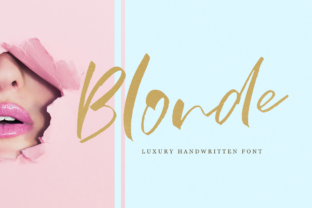
Blonde isn’t just another decorative typeface—it’s a thoughtful design tool built for clarity, warmth, and quiet confidence. With its elegant contrast, soft terminals, and balanced proportions, Blonde bridges the gap between approachability and sophistication. It’s not overly ornate, yet it carries presence. Not cold or clinical, but never saccharine. That balance is why designers, small business owners, educators, and creators consistently reach for Blonde when they need typography that supports their message—not overshadows it.
What Makes Blonde Stand Out
At its core, Blonde is a high-contrast serif with subtle calligraphic influence—notice how the thin strokes taper gently and the thick strokes hold weight without heaviness. Its x-height is generous, improving readability at smaller sizes, while its letterforms retain personality even in tight spaces. Unlike many display fonts that sacrifice function for flair, Blonde was crafted to work across contexts: from a printed wedding invitation viewed up close to a blog headline scanned on mobile.
It’s also highly legible in both light and dark mode interfaces, and its OpenType features—including stylistic alternates and ligatures—allow for nuanced expression without switching fonts. You’re not locked into one look; you can soften a quote with a delicate swash ‘Q’, tighten spacing for a clean logo lockup, or use alternate numerals for vintage-inspired book covers.
Creative Applications That Feel Intentional
Blonde thrives where tone matters as much as content. Consider these grounded, real-world uses:
- Wedding stationery: Pair Blonde’s roman weight with a muted ivory paper and fine cotton envelope. Use its italic for names and dates—no extra embellishment needed. The font itself conveys reverence and care.
- Small business branding: A local ceramic studio might use Blonde Bold for its shop sign (mounted cleanly on reclaimed wood), then switch to Blonde Light for product tags. Consistency comes from rhythm and proportion—not identical weights.
- Blog headers and featured quotes: On a wellness or education blog, Blonde in 36–48px size draws attention without shouting. Set body text in a neutral sans-serif (like Inter or Lato) to let Blonde breathe—and guide the reader’s eye where it matters most.
- Book and magazine covers: Fiction authors, indie publishers, and literary zines use Blonde to signal emotional resonance. Try it in deep navy or charcoal over matte paper—its serifs catch light just enough to feel tactile, not flashy.
- Home decor and personal prints: A framed quote in Blonde—printed on textured stock, hung beside a reading nook—feels curated, not generic. Its warmth invites pause. That’s rare in digital-first fonts.
Adapting Blonde Across Audiences and Platforms
How you apply Blonde depends less on rules and more on your audience’s expectations and the medium’s constraints.
For entrepreneurs launching a service-based business, Blonde works best when paired with strong visual hierarchy. Example: a coaching website uses Blonde SemiBold for the headline “Clarity Starts Here”, then switches to a clean sans-serif for bullet points and testimonials. The font signals professionalism and empathy—without implying formality that might distance newcomers.
Educators and course creators often use Blonde in slide decks or workbook covers—not for every line of text, but for section titles and reflective prompts (“What felt true today?”). Its gentle contrast reduces cognitive load compared to harsher serifs, supporting focus rather than distracting from learning goals.
On social media assets, Blonde shines in static visuals: Instagram quote cards, Pinterest pins, or printable workshop handouts. Avoid using it in video captions or fast-scrolling carousels—its elegance needs stillness to land. Instead, export headlines as crisp PNGs and layer them over photos with ample negative space.
Keeping Your Use Clear, Consistent, and Original
Blonde invites creativity—but consistency keeps it effective. Start with a simple system: choose one primary weight (e.g., Blonde Regular) for all headlines and one secondary (e.g., Blonde Light Italic) for accents or subheads. Limit yourself to two colors max when pairing with the font—black, deep gray, or warm sepia are reliable anchors.
Avoid over-styling. Don’t add drop shadows, excessive tracking, or gradient fills unless they serve a clear purpose (e.g., a gold foil effect on a luxury wedding suite). Let Blonde’s structure do the work. If your layout feels cluttered, step back and reduce—not add.
Originality comes from restraint and context, not novelty. A bakery in Portland uses Blonde in charcoal on kraft paper bags—simple, tactile, honest. A Berlin-based design studio uses the same font in crisp white on black for exhibition signage—equally authentic, entirely different mood. Same font. Different intention. That’s the power of thoughtful application.
Practical Next Steps
If you’re evaluating Blonde for an upcoming project, try this before licensing:
- Print three lines of your core message in Blonde Regular at 24pt, 36pt, and 48pt on plain paper. Read them aloud. Which size feels most natural for your use case?
- Test it alongside your current brand colors. Does it harmonize—or compete? Sometimes adjusting saturation (not hue) makes all the difference.
- Ask a colleague or ideal customer to glance at a mockup for five seconds. What’s the first word or feeling they recall? If it’s “elegant” or “calm” or “thoughtful”, you’re aligned.
Blonde doesn’t promise viral appeal or instant recognition. What it does offer is reliability—with character. It supports voice instead of replacing it. It helps ideas land with grace, whether you’re designing a logo for a yoga studio, typesetting a memoir, or handwriting a note to a friend with a custom Blonde stamp.
That’s the quiet strength of well-made typography: it disappears just enough to let meaning through—and stays long enough to be remembered.