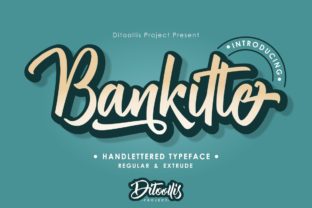
Bankitte: Where Playful Typography Meets Real-World Versatility
Typography isn’t just about legibility—it’s about resonance. It’s the first impression of a brand, the emotional tone of an invitation, the subtle signal of personality on a t-shirt or business card. Among the thousands of typefaces available today, Bankitte stands apart not by technical complexity, but by its unmistakable energy and adaptability. A playful and dynamic script font, Bankitte bridges the gap between hand-drawn charm and professional polish—making it far more than a decorative flourish. It’s a functional tool that thrives across contexts where authenticity, warmth, and visual distinction matter.
What Makes Bankitte Distinctive—Beyond “Cute”
At first glance, Bankitte invites comparison to casual brush scripts or calligraphic fonts. But closer inspection reveals thoughtful design decisions: balanced letter spacing, consistent stroke contrast, and carefully calibrated exit strokes that guide the eye without sacrificing rhythm. Unlike many script fonts that prioritize flourish over function, Bankitte maintains clarity even at smaller sizes—especially in uppercase settings or tightly spaced wordmarks. Its lowercase forms retain personality without descending into illegibility, and its alternates (where available) offer subtle variations for customizing tone—more relaxed for a yoga studio logo, slightly bolder for a boutique café menu.
Crucially, Bankitte avoids the pitfalls of over-stylization. It doesn’t rely on excessive swashes or exaggerated ligatures that break down in digital environments. Instead, it leans into confident simplicity—curves are smooth but grounded, terminals taper naturally, and baseline alignment remains stable across characters. This structural integrity is why designers consistently reach for Bankitte when they need script energy *without* sacrificing scalability or cross-platform reliability.
Real-World Applications: From Concept to Shelf
Bankitte’s strength lies in how seamlessly it transitions from idea to execution—across physical and digital touchpoints. Consider these practical scenarios:
- Invitations & Stationery: Wedding suites, birthday announcements, and baby shower cards benefit immensely from Bankitte’s approachable elegance. It conveys celebration without formality—ideal for modern couples who want warmth over tradition. Designers often pair it with clean sans-serifs (like Inter or Lato) for body text, letting Bankitte anchor headlines and names while ensuring readability in fine print.
- Logos & Brand Identity: Small businesses—from artisanal bakeries to indie bookshops—use Bankitte to project friendliness and craftsmanship. A local pottery studio might set its name in Bankitte above a minimalist icon, instantly communicating handmade care. Because it scales well, the same logo works on a storefront sign, Instagram profile, and packaging sticker without reworking.
- Apparel & Merchandise: On t-shirts, tote bags, or enamel pins, Bankitte holds up remarkably well in screen printing and embroidery. Its moderate stroke weight prevents thin lines from disappearing during production, and its generous x-height ensures impact even on curved surfaces like mugs or caps. A fitness coach using “Move With Joy” in Bankitte on a workout shirt lands differently than a rigid geometric sans would—it feels human, encouraging, and unstudied.
- Covers & Editorial Design: Book covers, podcast artwork, and zine headers gain instant character with Bankitte. It performs especially well in title treatments where brevity is key: a memoir titled Halfway Home gains intimacy through Bankitte’s gentle curves; a poetry chapbook called Small Fires feels quietly urgent. Designers note that Bankitte rarely needs shadow or outline effects—its inherent contrast provides enough presence against textured or gradient backgrounds.
- Digital Interfaces & Social Content: While not intended for UI text, Bankitte excels in hero banners, email headers, and Instagram story graphics. When used sparingly—as a single-line headline or animated quote—it draws attention without overwhelming. One educator shared how she uses Bankitte in Canva templates for student welcome slides: “It makes the classroom feel inviting before the first lesson begins.”
Who Benefits Most—and Why
Bankitte serves a surprisingly wide spectrum of users—not because it’s generic, but because its core qualities align with diverse goals:
Small business owners appreciate how quickly Bankitte communicates brand voice. Launching a new skincare line? Bankitte in soft pastel tones on a matte label suggests gentleness and care—no lengthy brand guidelines needed. It shortens the cognitive load for customers: within seconds, they grasp whether this is clinical, luxurious, earthy, or joyful.
Educators and nonprofit communicators find Bankitte effective for lowering barriers. A literacy program’s reading challenge poster (“Read 10 Books This Summer!”) feels more inclusive and less intimidating in Bankitte than in a stern serif. Similarly, mental health resources use it in workshop handouts to soften messaging around sensitive topics—tone becomes part of the support system.
Independent creators—illustrators, lettering artists, crafters—leverage Bankitte as both inspiration and foundation. Its rhythm informs hand-lettered pieces; its spacing guides layout decisions in Procreate or Illustrator. Some use it as a base layer, then trace over it with custom flourishes, blending digital efficiency with analog texture.
Even developers integrating web fonts report smooth implementation. Bankitte’s relatively compact file size (especially in WOFF2 format) means fast loading, and its OpenType features—including standard ligatures and contextual alternates—are supported across modern browsers. No complex CSS workarounds are needed to achieve basic typographic refinement.
Practical Considerations Before You Commit
Like any expressive typeface, Bankitte shines brightest when matched thoughtfully to context. Here’s what experienced users emphasize:
- Avoid dense paragraphs. Bankitte is not a text face. Using it for body copy—even at 14px—introduces fatigue and reduces scanability. Reserve it for headings, quotes, labels, and short bursts of emphasis.
- Test contrast rigorously. Its medium-dark weight can recede on busy backgrounds or low-resolution screens. Always preview on actual devices—not just design software previews. A light background with Bankitte in deep charcoal often outperforms white-on-white or neon-on-black combinations.
- Respect hierarchy. Pairing Bankitte with overly ornate companions dilutes its impact. Strong contrast works best: a sturdy geometric sans-serif (e.g., Montserrat), a warm humanist sans (e.g., Nunito), or even a restrained serif (e.g., Merriweather) creates balance without competition.
- Check licensing scope. While many versions of Bankitte are available under desktop and web licenses, extended use—such as embedding in mobile apps or SaaS platforms—may require additional permissions. Always verify usage rights before scaling across products.
How Bankitte Fits Into Broader Design Trends
Bankitte didn’t emerge in isolation—it reflects deeper shifts in visual communication. Over the past decade, audiences have grown skeptical of hyper-polished, algorithmically optimized aesthetics. In response, brands increasingly favor type that signals humanity: slight irregularities, visible craft, and emotional immediacy. Bankitte embodies this shift—not as nostalgia, but as intentional warmth.
It also aligns with the rise of “micro-branding”: small-scale, community-rooted ventures that rely on distinctiveness over mass appeal. A neighborhood florist doesn’t need to look like a global chain; they need to feel known, trusted, and singular. Bankitte supports that mission by offering recognizability without repetition—each application feels bespoke, even when using the same font file.
Importantly, Bankitte resists trend exhaustion. Unlike fonts tied to fleeting aesthetics (e.g., ultra-thin serifs or distressed grunge styles), its foundations in rhythm, proportion, and clarity ensure longevity. Designers report using Bankitte across projects spanning five years—still fresh, still functional, still resonant.
Getting Started Thoughtfully
If you’re exploring Bankitte for the first time, begin small. Try it in one high-impact location: the headline of your next newsletter, the name on your portfolio thumbnail, or the tagline on your LinkedIn banner. Observe how it changes perception—not just aesthetically, but emotionally. Does it make your message feel lighter? More personal? More memorable?
Then expand deliberately. Test it across two contrasting mediums—say, a printed postcard and a mobile-responsive webpage header. Note where it sings and where it strains. Adjust color, size, and spacing—not the font itself. Bankitte rewards restraint: sometimes reducing tracking by 10 units or increasing line height by 4px yields more impact than swapping fonts entirely.
Finally, listen to your audience. A restaurant owner switched from a sleek sans-serif to Bankitte for their online reservation CTA button (“Book Your Table”) and saw a 12% lift in click-throughs. Not because Bankitte is “better,” but because it aligned more closely with how guests imagined the experience—welcoming, unhurried, human-scaled.
That’s the quiet power of Bankitte: it doesn’t shout. It invites. It doesn’t dominate. It connects. And in a world saturated with visual noise, that kind of intentionality isn’t just stylistic—it’s strategic.