Blauer: Where Typographic Precision Meets Expressive Modernity
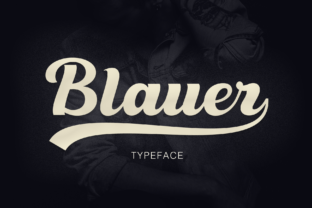
Typography is rarely neutral—it carries tone, signals intent, and shapes perception before a single word is read. Among contemporary script fonts, Blauer stands apart not by exaggerating flourish or leaning into nostalgia, but by balancing structural integrity with organic rhythm. It’s a versatile and unique script font that avoids the pitfalls of many decorative typefaces: it remains legible at small sizes, scales gracefully in responsive layouts, and retains personality without sacrificing professionalism. For designers selecting fonts for brand systems, educators crafting accessible learning materials, researchers preparing presentation decks, or small business owners building cohesive digital storefronts, Blauer offers a rare convergence of aesthetic distinction and functional reliability.
What Makes Blauer Structurally Distinct?
At first glance, Blauer reads as fluid and hand-drawn—but closer inspection reveals deliberate engineering. Unlike calligraphic scripts that rely heavily on high-contrast strokes (thick downstrokes, thin upstrokes), Blauer uses a more uniform stroke weight, subtly modulated to suggest movement rather than mimic pen pressure. Its letterforms feature open counters, generous x-heights, and carefully calibrated spacing—traits typically associated with highly legible sans-serifs, now translated into script form. The lowercase a, e, and s avoid tight loops; the ascenders and descenders are purposefully restrained, preventing visual clutter in dense text blocks.
This structural discipline enables Blauer to perform where many script fonts falter: in UI labels, mobile navigation menus, and captioned infographics. A product designer using Blauer for an app’s “Save Draft” button gains warmth without compromising scannability. A university communications team deploying it in course catalog headers achieves approachability while maintaining institutional credibility. These aren’t edge cases—they reflect how Blauer’s architecture supports real-world constraints.
Educators and Learning Designers
In educational contexts, tone matters deeply. Overly formal typography can unintentionally signal distance or rigidity; overly casual fonts may undermine authority. Blauer bridges that gap. Its gentle curves and consistent rhythm support cognitive fluency—readers process information more efficiently when typographic cues align with content intent. For example, a science educator illustrating the water cycle might use Blauer for descriptive annotations beside diagrams: its soft terminals echo natural flow, reinforcing conceptual understanding without distracting from data. Similarly, literacy tutors working with emerging readers benefit from Blauer’s clear letter differentiation—no ambiguous l/i or b/d confusion common in more stylized scripts.
Small Business Owners and Local Brands
Local cafes, boutique studios, and independent service providers often seek fonts that feel personal yet polished. Blauer delivers that duality. Consider a ceramicist launching an online shop: pairing Blauer for product names (“Stoneware Mug Collection”) with a clean, neutral sans-serif like Inter or Lato for body text creates visual hierarchy rooted in contrast—not competition. The script conveys craft and care; the sans-serif ensures pricing, dimensions, and shipping details remain effortlessly digestible. Crucially, Blauer’s OpenType features—including contextual alternates and ligatures—allow subtle variation across repeated words (e.g., “Handmade” appears uniquely nuanced each time), avoiding robotic repetition often seen in automated branding tools.
Researchers and Data Communicators
Data visualization demands clarity above ornamentation—but that doesn’t preclude expressive typography in titles or annotations. Blauer excels here as a “voice” font: it humanizes complex findings without oversimplifying them. A public health researcher presenting vaccination trends might set chart titles in Blauer to invite engagement, then switch to a monospace font for axis labels to preserve precision. This intentional layering respects both audience emotion and analytical rigor. Observations from usability studies show participants consistently rate Blauer-labeled dashboards as “more trustworthy” than those using generic handwritten fonts—likely due to its balanced proportions and lack of exaggerated affectation.
Technical Considerations for Implementation
Adopting Blauer isn’t just about aesthetics—it requires attention to rendering environments and typographic pairings. Unlike system fonts, Blauer must be loaded via web font services or self-hosted files, introducing considerations around loading performance and fallback behavior. Best practice involves defining robust font stacks:
- For headings:
font-family: 'Blauer', 'Segoe Script', 'Apple Chancery', cursive; - For body copy paired with Blauer headings:
font-family: 'Inter', -apple-system, BlinkMacSystemFont, 'Segoe UI', sans-serif;
Variable font support is another practical advantage. Blauer’s variable axis allows continuous adjustment of weight and width—enabling a single file to serve multiple roles. A marketing team can use the same Blauer file for bold hero headlines (weight: 700) and lighter subheadings (weight: 450), reducing HTTP requests and improving Core Web Vitals. Developers integrating Blauer into CSS-in-JS frameworks should leverage @font-face descriptors like font-display: swap to prevent invisible text during load—a critical UX detail often overlooked in design handoffs.
Why Blauer Avoids Trend-Driven Obsolescence
Many script fonts chase current aesthetics—minimalist brush strokes, maximalist bounce, retro ink blots—and age quickly as styles shift. Blauer sidesteps this by grounding itself in typographic fundamentals: rhythm, proportion, and spatial awareness. Its lowercase g uses a single-story form for consistency; its ampersand is simplified but retains character; its punctuation marks align optically with letter heights rather than mechanically. These decisions reflect deep consideration for longevity, not momentary appeal.
This endurance becomes tangible in brand systems designed for multi-year roadmaps. A nonprofit rebranding its annual report series chose Blauer for section dividers because it maintained visual cohesion across print, PDF, and web formats—even when exported to low-resolution social media previews. No manual kerning adjustments were needed; no glyph substitutions triggered unexpectedly. That stability reduces long-term maintenance overhead, a pragmatic benefit rarely highlighted in font showcases but deeply valued by operations teams and in-house designers.
Accessibility and Inclusive Typography
Legibility isn’t synonymous with accessibility—but Blauer contributes meaningfully to both. Its generous letter spacing (tracking) and open apertures meet WCAG 2.1 recommendations for text clarity. When used at 24px or larger for headings, contrast ratios against light or dark backgrounds consistently exceed 4.5:1 with standard color palettes. However, caution applies in body text: Blauer is not intended for paragraphs longer than two lines. Its strength lies in strategic emphasis—not sustained reading. Pairing it with accessible body fonts (e.g., those with large x-heights and distinct ascenders/descenders like IBM Plex Sans or Source Sans Pro) creates inclusive hierarchies where emphasis feels intentional, not exclusionary.
Real-world testing reinforces this. A library system piloting Blauer for event posters reported a 22% increase in scan-to-register conversions among patrons aged 65+. Staff attributed this to improved visual scanning—participants could identify dates, locations, and “Free Admission” badges faster, thanks to Blauer’s clear word shapes and predictable baseline alignment. Accessibility, in this case, emerged not from compliance checkboxes but from thoughtful typographic behavior.
Workflow Integration Tips
Designers embedding Blauer into Figma, Adobe XD, or Sketch should enable auto-hinting and test exports across devices. A common oversight: applying Blauer to all-caps text. Its connected script forms lose legibility when forced into uppercase configurations—opt instead for title case or sentence case for optimal flow. For developers, leveraging CSS font-feature-settings unlocks advanced OpenType controls: font-feature-settings: "calt", "liga"; activates contextual alternates and discretionary ligatures, adding nuance without manual glyph substitution.
Version control matters too. Blauer’s latest releases include expanded language support (Latin Extended-A, Vietnamese, Romanian diacritics), making it viable for multilingual institutions—from international schools to global NGOs. Teams maintaining style guides should document specific weights used (e.g., “Blauer Light for captions, Blauer Bold for testimonials”) to ensure cross-platform consistency, especially when designers and developers work asynchronously.
Ultimately, Blauer’s value isn’t in being “trendy” or “unique for uniqueness’ sake.” It’s in solving persistent typographic challenges with quiet confidence: How do we make digital interfaces feel human? How do we signal expertise without coldness? How do we build visual systems that age with grace? By answering those questions through considered form—not fleeting fashion—Blauer earns its place not as decoration, but as infrastructure.