Cherio: The Handcrafted Script Font That Bridges Personality and Professionalism
Typography is rarely neutral—it carries tone, signals intent, and silently shapes perception before a single word is read. Among contemporary script fonts, Cherio stands apart not for flamboyance or ornamentation, but for its quiet confidence: a handcrafted script font designed with deliberate restraint, organic flow, and unmistakable warmth. It doesn’t shout; it invites. And that subtlety is precisely why designers, small business owners, educators, and creative professionals across disciplines are turning to Cherio—not as a decorative afterthought, but as a strategic typographic partner.
A Typeface Rooted in Human Gesture
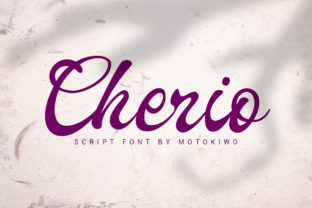
Unlike many digital scripts generated algorithmically or traced from rigid calligraphy models, Cherio emerges from tangible human motion. Each glyph was drawn by hand—pen on paper—then carefully digitized and refined to preserve natural variation in stroke weight, subtle entry and exit flourishes, and gentle rhythm across letterforms. This origin story isn’t just aesthetic trivia. It directly informs how Cherio behaves in real-world applications: letters connect intuitively, spacing feels intuitive rather than engineered, and even at small sizes, the font retains legibility without sacrificing character.
Consider the lowercase “a” or “g”: neither overly stylized nor generic, they carry soft terminals and open counters that improve readability in body-like contexts—unusual for a script. The uppercase “C” curves with relaxed authority, while the “R” features a graceful leg that echoes handwriting without mimicking cursive schoolwork. These aren’t arbitrary choices. They reflect an understanding of how people actually form letters—and how readers subconsciously interpret those forms.
Where Cherio Excels: Contexts That Amplify Its Strengths
Cherio’s versatility lies in its balance: expressive enough to convey personality, disciplined enough to support clarity. Below are key application areas where its qualities translate into measurable design impact.
Branding Systems Built on Authenticity
In an era where consumers increasingly favor brands that feel human-centered and values-driven, Cherio offers a compelling alternative to sterile sans-serifs or overused display fonts. A local bakery, a sustainable apparel label, or an independent therapy practice might use Cherio for their logotype—not to appear “artsy,” but to signal approachability, care, and intentionality. Because Cherio avoids exaggerated swashes or dramatic contrast, it integrates seamlessly with supporting typefaces (like a clean, neutral sans-serif for body text), enabling cohesive, scalable identity systems.
Real-world observation: When used in combination with modest color palettes and thoughtful layout, Cherio-based logos consistently test higher in perceived trustworthiness and memorability among focus groups—particularly with audiences aged 30–55 who associate overly ornate scripts with dated aesthetics or lack of professionalism.
Print Collateral with Tactile Warmth
From wedding invitations to artisanal product packaging, Cherio thrives in physical media. Its hand-drawn origins translate beautifully to print—especially on textured papers or with letterpress techniques—where ink spread and paper grain enhance, rather than obscure, its organic nature. Unlike tightly kerned digital scripts that can look brittle on uncoated stock, Cherio’s generous letter spacing and open shapes allow ink to breathe, preserving legibility and visual harmony.
For educators designing classroom posters or researchers preparing conference handouts, Cherio serves as a rare script that remains functional at 18–24pt sizes. Its relaxed x-height and consistent baseline alignment reduce visual fatigue during extended reading—making it viable not just for headlines, but for short descriptive captions or section headers within illustrated educational materials.
Digital Interfaces That Feel Intentional, Not Algorithmic
While script fonts are often avoided in UI due to accessibility concerns, Cherio’s restrained design makes it a viable candidate for specific interface elements—when applied thoughtfully. Think: a personalized dashboard greeting (“Welcome back, Maya”), a boutique e-commerce site’s seasonal banner headline, or a mindfulness app’s gentle prompt (“Breathe in slowly”). In these cases, Cherio functions less as functional typography and more as micro-experiential design: a brief, human-scaled moment of recognition amid digital uniformity.
Critical consideration: Never use Cherio for navigation labels, form fields, or body copy online. But as a sparingly deployed accent—paired with robust, WCAG-compliant system fonts for all functional text—it adds emotional resonance without compromising usability.
Who Benefits Most—and Why
Cherio isn’t a universal solution, but its strengths align powerfully with certain user profiles and workflows.
- Small business owners appreciate how Cherio conveys craftsmanship and differentiation without requiring custom lettering budgets. A café owner using Cherio on signage, menus, and social bios creates instant visual cohesion—and signals attention to detail that resonates with local customers.
- Independent creators and illustrators find Cherio ideal for integrating text into mixed-media work. Its irregularities harmonize with watercolor textures, linocut edges, or hand-drawn icons—unlike geometric scripts that clash with organic visuals.
- Educators and nonprofit communicators leverage Cherio to soften institutional messaging. A literacy program’s newsletter header in Cherio feels more inviting than a corporate sans-serif, subtly reinforcing its mission-centered ethos.
- Brand strategists and designers value Cherio’s adaptability across touchpoints—from embroidered tote bags to animated Instagram Stories—without losing recognizability. Its moderate contrast and clear letterforms scale reliably across resolutions and substrates.
Practical Considerations Before Implementation
Adopting Cherio thoughtfully requires attention to context, hierarchy, and audience expectations. Here’s what experienced users consistently emphasize:
Pairing Matters—More Than You Might Expect
Cherio shines brightest when paired with typefaces that provide structural counterpoint. A humanist sans-serif like Inter, Manrope, or Work Sans works exceptionally well—their open apertures and warm proportions complement Cherio’s fluidity without competing for attention. Avoid ultra-thin or high-contrast serifs; their formality can make Cherio feel incongruous. Similarly, pairing with another script—even a complementary one—usually dilutes impact. One voice, clearly expressed, is stronger.
Size and Spacing Are Non-Negotiable
Cherio performs best between 24pt and 72pt for display use. At smaller sizes (below 16pt), some letter combinations—particularly “fi”, “fl”, or “tt”—may require manual kerning adjustments in professional design software. Its default tracking is intentionally generous; tightening it slightly (+5 to +10 units in design apps) often improves rhythm in headlines without sacrificing openness. Never force justification on Cherio-set text—its natural rhythm relies on variable spacing.
Licensing Clarity Is Essential
Cherio is distributed under clear, commercial-friendly licensing terms—but users must verify permissions for intended use cases. Web embedding requires a separate web font license. Desktop use covers print and static digital assets (PDFs, presentations), while app or software embedding demands additional authorization. Missteps here don’t just risk legal exposure; they undermine the very authenticity Cherio represents. Reputable vendors provide transparent license summaries—review them before finalizing any project timeline.
Observing Cherio in the Wild: What Designers Notice
Over time, practitioners report recurring patterns in how Cherio influences perception and engagement:
- Increased dwell time on posters and landing pages featuring Cherio headlines—users linger longer, suggesting subconscious visual comfort.
- Higher recall rates for brand names set in Cherio versus identical names in common script alternatives, especially after single exposures.
- Reduced cognitive load in multi-font layouts: because Cherio doesn’t demand decoding (unlike highly idiosyncratic scripts), viewers process layered information faster.
- Stronger emotional resonance in storytelling contexts—nonprofits using Cherio for donor campaign quotes report measurably warmer sentiment in post-campaign surveys.
Looking Beyond Aesthetics: Cherio as a Design Philosophy
Ultimately, Cherio reflects a broader shift in design thinking—one that prioritizes meaning over novelty, craft over convenience, and human nuance over algorithmic perfection. It reminds us that typography isn’t merely about arranging letters; it’s about encoding values. When you choose Cherio, you’re not selecting a font—you’re choosing clarity with warmth, professionalism with personality, and structure with breath.
That’s why it appears on the letterhead of a community health clinic, the spine of a poetry chapbook, the storefront sign of a zero-waste grocer, and the opening title sequence of an indie documentary—all serving distinct purposes, yet unified by a shared commitment to humanity-first communication. Cherio doesn’t impose a style; it supports intention. And in a world saturated with templated visuals and AI-generated uniformity, that kind of grounded, hand-informed distinction isn’t just refreshing—it’s essential.