Raconteurs: A Refined Calligraphy Font for Elegant, Luxurious Design
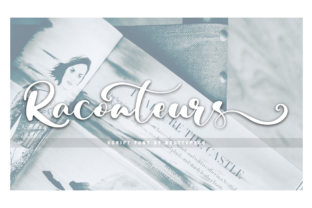
Raconteurs is a hand-drawn calligraphy script font designed with deliberate grace and subtle sophistication. Unlike many decorative scripts that lean heavily into ornate flourishes or exaggerated contrast, Raconteurs balances fluidity with restraint—its letterforms feature soft entry and exit strokes, gentle modulation in stroke weight, and a natural rhythm reminiscent of skilled penmanship. It’s not merely decorative; it carries intentionality in its spacing, kerning, and character set, making it functionally viable beyond visual appeal.
What Sets Raconteurs Apart from Other Script Fonts
Many script fonts fall into two broad categories: highly formal (think tightly spaced, high-contrast copperplate styles) or loosely casual (bouncy, irregular, often inconsistent in baseline alignment). Raconteurs occupies a nuanced middle ground. Its lowercase ‘a’, ‘g’, and ‘y’ include graceful, open counters—not overly tight, not distractingly loose. The uppercase letters retain elegance without rigidity, and the connecting strokes between characters are smooth but never forced, allowing for readability even at moderate sizes.
This balance makes Raconteurs especially effective where tone matters as much as legibility—such as wedding stationery, boutique branding, or editorial features in lifestyle magazines. It conveys warmth and refinement without appearing dated or overly precious. That distinction becomes clear when comparing it to scripts with heavier swashes (which can overwhelm small layouts) or ultra-thin variants (which lose impact in print or on low-resolution screens).
Practical Strengths in Real-World Use
Raconteurs excels in applications where emotional resonance supports the message. For example:
- Wedding postcards and invitations: Its soft curves and rhythmic flow complement romantic, timeless aesthetics—especially when paired with muted palettes or textured paper stocks.
- Branding for luxury or wellness-focused businesses: A skincare line, artisanal bakery, or independent bookstore might use Raconteurs in a logo lockup or headline treatment to signal care, craftsmanship, and quiet confidence.
- Greeting cards and quote-based social graphics: Because of its generous x-height and open letterforms, Raconteurs remains legible even when scaled down to 18–24pt in body text treatments—uncommon for many high-contrast scripts.
- Editorial design: Magazines covering culture, travel, or interior design sometimes use Raconteurs for pull quotes or section headers—adding personality without sacrificing hierarchy.
Its OpenType features—including contextual alternates and ligatures—further support typographic nuance. These aren’t just decorative extras; they help avoid repetitive character combinations (like double ‘o’s or ‘fl’ pairs), giving each word a more organic, hand-crafted feel.
Where Raconteurs Fits—and Where It Doesn’t
Like any specialized tool, Raconteurs has natural boundaries. It works best when used selectively—not as a full-body text face, but as a voice for emphasis, identity, or mood. Its strengths lie in controlled environments: headlines, logos, short phrases, and carefully composed layouts. Attempting to set long paragraphs or dense product descriptions in Raconteurs will compromise both usability and accessibility.
It also assumes a certain level of typographic awareness from the designer. Pairing Raconteurs effectively requires thoughtful contrast—for instance, a clean, neutral sans serif (like Montserrat or Lora) for supporting text. Without that counterbalance, the script can dominate or clash, especially in digital interfaces where screen rendering varies.
Readers evaluating Raconteurs should consider their project’s scale and context. If you’re designing a minimalist business card for a financial advisor, Raconteurs may feel tonally misaligned—even if technically possible. Similarly, for tech startups emphasizing speed and clarity, its lyrical pacing may undercut messaging goals. In those cases, a more structured script—or even a refined serif—might serve better.
Comparison Considerations: Style, Function, and Fit
When exploring script fonts, users often weigh three interrelated factors: aesthetic harmony, functional flexibility, and production readiness. Raconteurs scores highly on the first two—but only if the third aligns with your workflow.
For instance, some script fonts rely heavily on automatic glyph substitution (via software like Adobe Illustrator or Affinity Designer) to activate ligatures and alternates. Raconteurs includes these features, but they require manual activation or proper OpenType-aware applications. Users working primarily in Canva or basic word processors may not access its full potential without extra steps—like converting text to outlines (which sacrifices editability).
Also worth noting: Raconteurs was designed with print-first sensibilities—its spacing and weight distribution anticipate physical output. On-screen, particularly at smaller sizes or on lower-DPI displays, some fine details (like delicate hairlines in uppercase ‘T’ or ‘K’) may soften or disappear. That doesn’t diminish its value, but it does mean testing across intended outputs is essential—not an afterthought.
Realistic Decision Factors
Ask yourself these questions before choosing Raconteurs:
- Is the project centered on evoking elegance, intimacy, or craftsmanship? If yes, Raconteurs aligns well. If the goal is neutrality, urgency, or technical authority, another option may be more appropriate.
- Do you have control over typography implementation? Raconteurs benefits from professional design tools and some familiarity with OpenType settings. If your workflow is constrained (e.g., CMS templates with limited font controls), simpler alternatives may offer more predictable results.
- What’s the primary medium—print, web, or both? Raconteurs shines in print. For web use, ensure fallbacks are defined and test rendering across browsers. Variable font versions (if available) could improve performance, though Raconteurs itself is currently offered as static weights.
- How much customization do you need? While Raconteurs offers stylistic sets, it isn’t a variable font with adjustable axes (like weight or width). If your project demands dynamic responsiveness—say, shifting stroke contrast based on viewport size—you’ll need complementary solutions.
Alternatives Worth Considering—Depending on Need
No single font serves every purpose. If Raconteurs resonates but falls short in a specific area, consider these directional alternatives:
- For greater versatility across sizes: A slightly more robust script with tighter spacing and stronger contrast—still elegant, but engineered for broader application.
- For digital-first projects requiring full OpenType support: Look for fonts explicitly optimized for web embedding, with WOFF2 variants and tested cross-browser behavior.
- For tighter budget or licensing constraints: Some high-quality free or low-cost scripts offer comparable elegance—though often with reduced character sets or fewer stylistic options.
- For brand systems needing multiple weights or widths: A matched serif/sans + script trio may provide more structural flexibility than relying on one expressive face alone.
Ultimately, Raconteurs isn’t about replacing other tools—it’s about offering a distinct voice within a broader typographic toolkit. Its value emerges not in isolation, but in how thoughtfully it integrates with surrounding elements, audiences, and intentions.
Making an Informed Choice
Selecting a script font involves more than visual preference. It’s about matching tone to audience expectation, balancing beauty with function, and anticipating how the type will behave across formats and contexts. Raconteurs succeeds where subtlety, cohesion, and emotional authenticity matter—particularly in premium, personal, or narrative-driven work.
If your goal is to convey care in detail—to make a reader pause, recognize craft, and feel invited rather than instructed—Raconteurs provides a credible, cohesive foundation. But if speed, scalability, or strict functional neutrality take priority, stepping back to evaluate adjacent options is both reasonable and responsible.
There’s no universal “best” script. There’s only the right one—for this project, this audience, and this moment. Raconteurs earns its place when those conditions align.