Winterfall: A Modern Blackletter Font
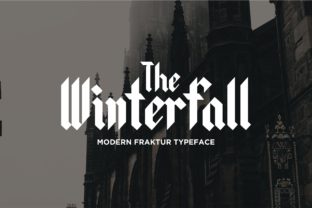
Winterfall is a carefully crafted blackletter font that bridges centuries — rooted in the bold, ornate letterforms of 16th-century Europe, yet refined for today’s screens, print projects, and creative workflows. It’s not a historical replica or a decorative gimmick. Instead, Winterfall is a functional, versatile typeface designed to bring gravitas, character, and distinction to your work — without sacrificing readability or modern usability.
What Makes Winterfall Stand Out?
At first glance, Winterfall commands attention. Its sharp serifs, high contrast strokes, and rhythmic angularity echo medieval manuscripts and early printed books — think illuminated initials, heraldic banners, or engraved bookplates. But unlike many blackletter fonts, Winterfall avoids excessive density or visual noise. Its letter spacing is open, its lowercase forms are legible even at smaller sizes, and its capitals have strong presence without overwhelming surrounding text.
This balance is intentional. The designer reinterpreted traditional blackletter structure with contemporary typographic principles: consistent x-heights, improved kerning pairs, and subtle optical adjustments that help it perform well across devices and media. That means Winterfall doesn’t just look impressive in a logo or headline — it holds up in body text on a blog post, a presentation slide, or a product label.
Where Winterfall Fits Into Real Projects
Whether you're launching a small business, designing a personal portfolio, or creating classroom materials, Winterfall adds a layer of intentionality and craftsmanship. Here’s how people actually use it:
- Branding & logos: Craft breweries, artisanal bakeries, boutique bookshops, and independent record labels often choose Winterfall to signal heritage, authenticity, and attention to detail — especially when paired with clean sans-serif supporting text.
- Digital content: Bloggers and educators use Winterfall for section headers, quote blocks, or course module titles to create visual hierarchy and memorable moments in long-form content.
- Print & packaging: Small-batch candle makers, handmade soap brands, and indie stationery designers apply Winterfall to labels, tags, and greeting cards — where tactile quality and typographic personality matter.
- Invitations & announcements: Wedding suites, gallery openings, and academic symposia benefit from Winterfall’s ceremonial tone and timeless elegance.
It’s also popular among hobbyists exploring calligraphy-inspired design. Because Winterfall maintains clear stroke direction and rhythm, it works beautifully alongside hand-drawn elements, ink textures, or scanned paper backgrounds — helping digital work feel warm and human-made.
Why People Choose Winterfall Over Other Blackletter Fonts
Many blackletter fonts fall into one of two traps: they’re either too rigid and hard to read, or too playful and lose their authority. Winterfall avoids both extremes. Its design respects tradition but doesn’t imitate it slavishly — making it more adaptable than purely historical alternatives.
For beginners, that adaptability matters. You don’t need advanced typography knowledge to start using Winterfall effectively. Try pairing it with a neutral sans-serif like Inter, Lato, or Montserrat for immediate contrast and clarity. Use it sparingly — for headlines, pull quotes, or short phrases — and let its character shine without competing with itself.
Professionals appreciate that Winterfall includes full Latin character support, standard ligatures, and OpenType features like stylistic alternates and small caps. These aren’t just “nice-to-haves.” They let you fine-tune tone: swap a formal ‘&’ for a more decorative ampersand, adjust the weight of a single word, or set an elegant subheading in small caps.
Things to Keep in Mind Before Using Winterfall
Like any expressive font, Winterfall works best when matched thoughtfully to its context. Here are practical considerations:
- Avoid overuse in long paragraphs. While readable, blackletter styles demand more cognitive effort than simple sans-serifs. Reserve Winterfall for emphasis — not endurance.
- Test contrast and size carefully. On low-resolution screens or in dim lighting, fine details can blur. Always preview at actual usage size, especially for mobile interfaces or printed materials.
- Check licensing for commercial use. Some versions of Winterfall are free for personal projects but require a license for client work, merchandise, or web embedding. Make sure you select the right version upfront.
- Consider your audience. While many find Winterfall evocative and distinctive, others may associate blackletter with specific cultural or historical references. If your project targets a broad or international audience, test reactions with a few trusted reviewers.
A Few Simple Ways to Get Started
You don’t need design software experience to explore Winterfall. Start small:
- Download the free trial (if available) and install it on your computer.
- Open a blank document in Word, Google Docs, or Canva and type a short phrase — like “Handcrafted Since 2023” or “Winter Edition” — in Winterfall at 36pt. Notice how the rhythm changes the mood instantly.
- In Canva or Figma, layer Winterfall over a muted background photo of wood grain or parchment — no extra effects needed. See how much presence it brings with minimal effort.
- Try exporting a one-page PDF poster using Winterfall for the title and a clean sans-serif for the rest. Print it or share it digitally to gauge real-world impact.
These small experiments reveal what makes Winterfall special: it doesn’t shout. It settles in — confident, grounded, and quietly unforgettable.
Final Thought: Type With Purpose
Fonts shape how people feel before they even read a word. Winterfall invites intention. It asks you to pause and consider tone, audience, and message — not just aesthetics. Whether you’re naming a new podcast, designing a workshop handout, or refreshing your website header, choosing Winterfall signals care. Not perfection — just care.
That’s why so many creators return to it again and again. Not because it’s trendy, but because it feels earned — like a well-worn tool that gets better with thoughtful use.