Barleycorn: A Vintage Serif with Character
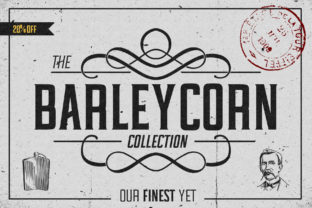
Barleycorn isn’t just another serif font—it’s a deliberate nod to the tactile charm of mid-century packaging, apothecary labels, and hand-printed bookplates. Designed with intention, not trend-chasing, it carries the quiet confidence of well-crafted typography from an era when type had weight, warmth, and personality. Its retro sensibility comes not from imitation, but from thoughtful reinterpretation: sturdy serifs, open counters, and generous x-heights that balance readability with distinctiveness. And unlike many “vintage” fonts that lean heavily into distress or ornament, Barleycorn stays clean, functional, and surprisingly versatile—especially with its built-in illustrations.
More Than Just Letters: What Makes Barleycorn Stand Out
At its core, Barleycorn is a dual-purpose tool. It includes two weights—regular and light—each carefully tuned for contrast and clarity across sizes. The regular weight holds presence in headlines and signage; the light weight breathes quietly in captions, pull quotes, or delicate branding elements. But what truly sets Barleycorn apart is its integrated illustration set: botanical motifs, geometric flourishes, monogram frames, and subtle borders—all drawn in the same hand-informed rhythm as the letterforms. These aren’t clip-art add-ons. They’re harmonized in scale, line weight, and stylistic voice, so they feel like natural extensions of the type itself.
This cohesion matters. When your headline, subhead, and supporting graphic all share the same visual DNA, your design gains internal consistency without extra effort. That’s especially valuable for creators working solo—designers building brand identities, educators crafting classroom materials, or small business owners updating their product labels or social media visuals.
Creative Uses That Feel Authentic, Not Forced
Vintage aesthetics can easily slip into pastiche—especially when applied without context. Barleycorn avoids that trap by offering substance alongside style. Here’s how different users bring it to life meaningfully:
- Small business owners use Barleycorn for product labels on artisanal goods—think small-batch honey, herbal teas, or handmade soaps. The light weight pairs cleanly with ingredient lists; the regular weight anchors the brand name; and a simple barley stalk or wheat motif reinforces origin and craft without saying a word.
- Educators and curriculum designers apply it to printable worksheets, reading guides, or historical project templates. Its high legibility at smaller sizes (uncommon in many retro serifs) means students can read comfortably—even on printed handouts—and the illustrations add visual scaffolding without distraction.
- Bloggers and content creators deploy Barleycorn selectively: a bold Barleycorn headline over a neutral sans-serif body text creates instant hierarchy and tone. One well-placed illustration—like a vintage-style divider between sections—adds texture and breaks up long-form content without compromising speed or accessibility.
- Freelance designers build flexible brand systems around Barleycorn’s two weights and illustrations. For a local bakery, they might combine the regular weight for the logo, light for menu headers, and custom-cropped illustrations as repeating patterns on packaging or website backgrounds—always respecting spacing, contrast, and purpose.
Staying Clear, Consistent, and Audience-Friendly
Using Barleycorn well means resisting the urge to over-decorate. Its strength lies in restraint. Start with function: Is this text meant to be read quickly? Then prioritize the regular weight at an appropriate size with generous line height. Is it meant to evoke mood or place? Then layer in one illustration—not three—and anchor it near related content (e.g., a sprig beside a “locally sourced” tagline).
Also consider platform constraints. On screens, avoid setting Barleycorn too small in the light weight—its fine details may soften or disappear on lower-resolution displays. In print, embrace its richness: use it at larger sizes where the serifs and illustration lines hold crispness. And always test contrast. Pair it with neutral, highly legible sans-serifs (like Inter, Lato, or even system fonts) for body copy—never compete with itself.
Real Projects, Real Results
A Portland-based candle maker recently refreshed their label design using Barleycorn. Instead of relying on stock “vintage” graphics, they used the included botanical illustrations—scaled and rotated—to form a subtle border around each label. The brand name sits in Barleycorn Regular; scent notes appear in Light. No filters, no textures—just intentional typography and smart spacing. Customers report the packaging feels “thoughtful” and “trusted,” not nostalgic for nostalgia’s sake.
Similarly, a university history department redesigned their seminar flyers using Barleycorn for titles and key dates, then pulled in the monogram-style frames to highlight guest speaker names. The result? Materials that signal academic rigor while feeling approachable—no stodgy Times New Roman, no distracting gradients.
Getting Started—Without Overcomplicating It
You don’t need a full brand guide to begin. Try this practical sequence:
- Pick one use case: a social media banner, a product tag, a chapter title in a self-published zine.
- Choose the weight that matches the role: Regular for impact, Light for subtlety.
- Add *one* illustration—aligned, spaced, and sized to support, not dominate.
- Step back. Does it communicate clearly? Does it feel cohesive? If yes, you’re on solid ground.
Barleycorn works best when treated as a collaborator—not a shortcut. It won’t fix weak messaging or inconsistent color choices. But in the hands of someone who values clarity, craft, and quiet confidence, it becomes a reliable tool for making work that feels both grounded and distinctive.
Why This Kind of Type Still Matters
In a landscape saturated with ultra-thin fonts, variable axes, and AI-generated “vibes,” Barleycorn stands out by being human-scaled and human-made. It doesn’t try to do everything. It does a few things very well: convey heritage without cliché, support storytelling with visual rhythm, and give small projects the polish of careful attention. That’s not just aesthetic preference—it’s respect for your audience’s time, your own creative energy, and the real-world contexts where your work lives.
So whether you’re designing a wedding invitation, updating a nonprofit’s annual report, or launching a new line of ceramic mugs, Barleycorn offers more than nostalgia. It offers a clear, consistent, and quietly confident way to say something worth remembering.