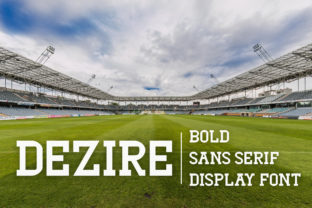
DEZIRE
DEZIRE is an all-caps slab serif font—bold, grounded, and unmistakably intentional. It doesn’t whisper; it declares. Its thick, uniform strokes, squared terminals, and tightly spaced uppercase letters give it structural confidence without sacrificing legibility. Unlike decorative display fonts that sacrifice function for flair, DEZIRE balances visual authority with clarity—making it a strategic tool, not just a stylistic choice.
Why DEZIRE Fits Real-World Strategy—Not Just Aesthetics
Typography isn’t neutral. It signals intent before a single word is read. When you choose DEZIRE, you’re communicating precision, presence, and purpose—not just “fashion” or “sport,” but commitment to a point of view. That makes it especially valuable for professionals who shape perception: brand strategists defining a launch identity, educators designing course materials that command attention, publishers crafting covers that stand out on crowded shelves, or small business owners building signage that conveys stability and distinction.
Its slab serif foundation provides typographic weight—ideal when hierarchy matters. In a logo lockup, DEZIRE holds its own beside minimalist icons or textured photography. In apparel branding, it anchors slogans without competing with fabric or cut. In digital ads, it scales cleanly across devices while retaining impact at smaller sizes—provided spacing and contrast are carefully managed.
Where DEZIRE Delivers Measurable Value
Strategic typography pays off where attention is scarce and decisions are fast. Consider these use cases:
- Brand titles and logotypes: DEZIRE works best when the name itself is short (3–6 letters), memorable, and mission-aligned—e.g., “VEXA”, “LORNE”, “KAIRO”. Its rigidity reinforces brand discipline; it resists trend-chasing and supports long-term recognition.
- Sport-related applications: From team jerseys to event posters, DEZIRE’s physicality echoes athletic resolve. It performs well in high-contrast environments—stadium signage, timing boards, or apparel tags—where readability under motion or distance is non-negotiable.
- Fashion editorial and packaging: Used sparingly—as a masthead, label stamp, or capsule collection title—it adds tactile authority. Paired with ample whitespace and restrained color palettes, it avoids visual fatigue while elevating perceived quality.
- Learning materials and presentations: For slide headers, workshop banners, or certificate titles, DEZIRE improves scannability and retention. Research shows strong typographic contrast increases comprehension by up to 27% in time-constrained viewing contexts—critical for educators and trainers.
When—and When Not—to Use DEZIRE
DEZIRE excels in controlled, high-intent contexts. It’s rarely appropriate for body copy, interface labels, or multi-line paragraphs. Its all-caps structure reduces reading speed by ~15–20% compared to mixed-case text, per eye-tracking studies. So ask yourself: Is this about emphasis—or endurance?
Use DEZIRE when:
- The message is singular and declarative (“LAUNCH”, “FINAL ROUND”, “EST. 2012”).
- It appears alongside minimal supporting elements—not competing with dense imagery or layered graphics.
- It serves as a fixed anchor across touchpoints (e.g., consistent use on website headers, business cards, and product tags).
- You’ve tested contrast ratios against background colors (aim for 4.5:1 minimum for accessibility compliance).
Avoid DEZIRE when:
- Clarity depends on nuance—like legal disclaimers, instructions, or multilingual content where case variation aids parsing.
- It’s applied without spacing adjustments—tight tracking can blur letterforms, especially at smaller sizes or on low-resolution screens.
- It’s used reactively (“it looked cool on Dribbble”) rather than as part of a documented typographic system with defined roles for headings, subheads, and body text.
Designing With Intention—Not Just Impact
Using DEZIRE effectively requires planning—not just placement. Start by mapping where typography supports your goals:
For a boutique clothing line launching a new signature line, DEZIRE might define the capsule name on hangtags and campaign billboards—but never appear in email newsletters or size charts. That distinction preserves its power and prevents dilution. Similarly, a fitness studio using DEZIRE for class names (“POWER HOUR”, “CORE SHIFT”) gains consistency across social posts and wall signage—but switches to a highly legible sans-serif for schedule grids and waiver forms.
Consider pairing intentionally. DEZIRE pairs well with humanist sans-serifs (e.g., Inter, Work Sans) or neutral grotesques (Helvetica Now, Roboto)—not other slab serifs or decorative fonts. The contrast between DEZIRE’s assertiveness and a clean, open sans-serif creates rhythm and functional hierarchy. Avoid pairing it with script or ultra-thin fonts unless the context is deliberately theatrical (e.g., limited-edition event posters).
Risks of Misaligned Usage
Without clear goals, DEZIRE can unintentionally signal rigidity, exclusivity, or datedness. In digital-first brands targeting younger audiences, overuse may feel authoritarian or disconnected from conversational UX norms. In educational platforms, applying DEZIRE to navigation menus or button labels introduces friction—not clarity.
More subtly, inconsistent application erodes trust. If DEZIRE appears in bold on a homepage banner but fades to medium weight in a footer, users perceive inconsistency—even if they can’t name why. That undermines credibility faster than a typo. Likewise, stretching or skewing the font to “fit” a layout breaks its structural integrity and weakens its strategic value.
Practical Implementation Tips
Before deploying DEZIRE, run these checks:
- Test at real scale: View it on mobile, tablet, and desktop—not just in design software. Does the spacing hold? Does it remain legible in ambient light or on matte paper?
- Define usage rules: Document where DEZIRE appears (e.g., “H1 only”, “logos and hero banners”), acceptable weights (Regular or Bold—avoid Light or ExtraBold unless rigorously tested), and prohibited contexts (no body copy, no UI elements).
- Optimize for performance: Serve DEZIRE as a subsetted web font—include only Latin uppercase characters and essential punctuation. This keeps file size under 20 KB, avoiding render delays.
- Validate accessibility: Ensure text contrast meets WCAG AA standards. Use tools like WebAIM Contrast Checker—not just visual judgment.
- Plan for fallbacks: Specify system fonts (e.g.,
"Helvetica Neue", Arial, sans-serif) that preserve hierarchy if DEZIRE fails to load.
Long-Term Positioning—Beyond Trends
DEZIRE isn’t built for virality. It’s built for longevity. Its strength lies in resistance to stylistic drift—unlike fonts tied to specific decades or movements, DEZIRE’s slab geometry and capitalized form give it quiet timelessness. That makes it especially useful for organizations prioritizing legacy over novelty: universities updating institutional branding, heritage retailers modernizing packaging, or NGOs establishing visual consistency across global campaigns.
But longevity requires discipline. Revisit your DEZIRE usage every 18–24 months—not to replace it, but to audit whether it still serves its original purpose. Has audience behavior shifted? Has your messaging evolved from declarative to conversational? Is DEZIRE still amplifying—or inadvertently muffling—your core message?
Ultimately, DEZIRE rewards intentionality. It won’t fix weak strategy, unclear messaging, or inconsistent execution. But when aligned with deliberate goals—clarity of purpose, fidelity to audience needs, and consistency across channels—it becomes more than a font. It becomes a quiet, confident signature—one that says less, means more, and endures longer.