Picanto: A Distinctive All-Caps Floral Font for Purposeful Design
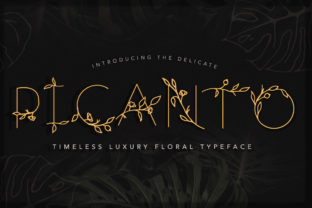
Picanto is an all-caps decorative typeface distinguished by its graceful floral motifs—delicate stems, soft curves, and organic flourishes integrated directly into the letterforms. Unlike script fonts that mimic handwriting or geometric sans-serifs built on rigid structure, Picanto occupies a thoughtful middle ground: it’s formal enough for elegant applications yet expressive enough to convey warmth and artistry. It comes in two weights—regular and bold—each carefully drawn to maintain visual harmony at varying sizes and contexts.
What Sets Picanto Apart from Other Decorative Fonts
Many decorative fonts prioritize either ornamentation or legibility—but rarely both. Picanto balances them through intentional spacing, open counters, and restrained embellishment. Its floral elements are embedded within the letter architecture rather than added as external swashes or clip-art-style accents. This makes Picanto more versatile than highly stylized alternatives that risk becoming illegible below 24pt or overwhelming in dense text blocks.
For example, in wedding stationery, Picanto’s regular weight works well for names and dates on invitations, while the bold version anchors headings or monograms without competing with photography or foil stamping. In cosmetics packaging, its refined presence supports premium positioning—especially when paired with minimalist layouts—whereas overly busy or cartoonish fonts might dilute perceived quality.
Fitting Picanto Into Real-World Design Workflows
Picanto functions best as a display font—not for body copy, but for moments where tone and identity matter most. Think of it as a design tool for signaling intention: elegance, care, celebration, or artisanal craftsmanship. Its all-caps nature reinforces formality and clarity, eliminating lowercase ambiguity while preserving visual rhythm across short phrases.
Because it lacks lowercase letters, numerals, or punctuation variants beyond standard ASCII, designers should plan supporting text accordingly. A clean, neutral sans-serif (like Inter, Lato, or even a light-weight Helvetica) often pairs effectively with Picanto for secondary information—addresses on invitations, ingredient lists on product labels, or taglines beneath logos. This contrast avoids visual fatigue and keeps hierarchy clear.
Strengths in Context: Where Picanto Excels
Picanto shines in situations where brand voice benefits from subtle sophistication rather than loud novelty. Its strengths include:
- Consistent tone across touchpoints: Whether used on a boutique’s business card, a seasonal packaging label, or a digital banner ad, Picanto delivers cohesive visual language without requiring custom illustration.
- Scalability in print and digital: The bold weight holds up well in large-format signage; the regular weight remains legible on high-resolution screens—even at modest sizes like 18–20px for hero text.
- Adaptability to color and texture: Its balanced stroke contrast allows smooth reproduction in foil, embossing, or watercolor-inspired digital overlays without losing definition.
- Timelessness over trendiness: While some floral fonts lean heavily into maximalist or vintage tropes, Picanto’s restrained execution avoids dating quickly—making it suitable for brands planning multi-year identity systems.
Tradeoffs and Practical Considerations
No font solves every problem—and Picanto is no exception. Its all-caps limitation means it cannot support sentence-case typography, which may reduce flexibility in longer headlines or interface elements requiring mixed case. It also doesn’t include extended language support (e.g., accented characters for French or Spanish), so international campaigns may require fallback solutions or custom glyph additions.
Legibility becomes a factor in low-contrast environments—such as light gray Picanto text on a pale beige background—or when placed over busy imagery. In those cases, adding a subtle drop shadow, increasing letter-spacing slightly, or using the bold weight with tighter tracking can help maintain readability without sacrificing aesthetic intent.
Another consideration is licensing scope. Picanto is typically offered under desktop and webfont licenses with clear usage boundaries. Designers working across client projects should verify whether their license permits redistribution (e.g., embedding in a client’s Shopify theme) or extended use (e.g., merchandise, video intros). Misalignment here can lead to compliance issues down the line—so reviewing license terms early is part of responsible implementation.
When Picanto Is the Right Choice—And When It Isn’t
Picanto fits naturally when the goal is to elevate perception without sacrificing clarity. It’s often the right choice for:
- Brands in beauty, wellness, or lifestyle sectors seeking refined differentiation;
- Small-batch artisans launching packaging that must communicate craft and care;
- Designers creating one-off wedding suites where personalization and elegance coexist;
- Marketing teams building seasonal campaigns around themes like renewal, growth, or celebration.
Conversely, Picanto may not suit projects requiring:
- High-volume textual content (e.g., editorial layouts, long-form websites);
- Technical or corporate identities prioritizing neutrality, authority, or data-driven clarity;
- Applications demanding multilingual support or accessibility-first typography (e.g., WCAG-compliant interfaces);
- Budget-conscious initiatives where free or open-source alternatives better match resource constraints.
Comparing Approach, Not Just Appearance
Choosing Picanto isn’t just about liking how it looks—it’s about aligning its functional qualities with your project’s goals. Compare it less to other floral fonts and more to the role you need typography to play. Ask: Does this font help reinforce what the audience should feel? Does it support—not compete with—the message? Does it integrate smoothly into existing assets or require significant redesign?
In practice, designers sometimes test Picanto alongside simpler options—not to replace it, but to gauge contrast value. For instance, pairing Picanto with a humanist sans-serif reveals how much personality the floral font contributes. If removing Picanto leaves the layout feeling generic or emotionally flat, it’s likely doing meaningful work. If the difference is barely perceptible, reconsider whether the investment (in time, licensing, or production complexity) justifies the outcome.
Making an Informed Decision
Before committing to Picanto, download a trial version if available and test it in your actual environment—not just in a design mockup, but in final output conditions: printed on your intended stock, rendered on target devices, viewed at real-world distances. Test readability with colleagues or representative users, especially if the audience includes older adults or people with mild visual impairments.
Also consider how Picanto interacts with other brand elements. Does it complement your color palette? Does it sit comfortably beside photography styles or iconography? A font doesn’t exist in isolation—and Picanto’s floral character gains resonance when supported by consistent visual choices elsewhere.
Finally, reflect on longevity. Will this font still feel appropriate in 12 months? In three years? Fonts like Picanto succeed when they’re chosen for enduring values—clarity, warmth, distinction—not momentary trends. That kind of intentionality separates thoughtful typography from decorative afterthoughts.