Charganolton
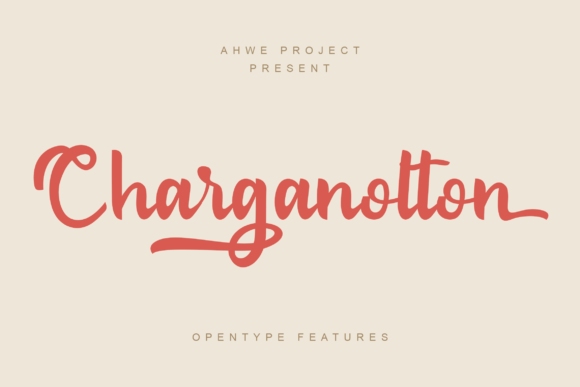
Charganolton isn’t just another script font—it’s a thoughtful blend of playfulness and polish, designed to carry your message with warmth, clarity, and quiet confidence. Whether you’re crafting a hand-lettered logo for a boutique bakery, designing an invitation for a milestone birthday, or adding personality to a social media graphic, Charganolton brings authenticity without sacrificing legibility or intention. Its gentle curves, balanced spacing, and subtle bounce make it feel handmade—but refined enough for professional use.
Why designers reach for Charganolton (and why some hesitate)
Many creators are drawn to Charganolton because it solves a real problem: how to stand out without shouting. In a world saturated with bold sans-serifs and overused brush scripts, Charganolton offers charm that reads as sincere—not cutesy, not forced. It works especially well for brands and projects rooted in care: wellness studios, children’s books, artisanal packaging, wedding stationery, and educational materials aimed at younger audiences or empathetic messaging.
Yet hesitation often comes from misunderstanding what Charganolton is built to do—and what it isn’t. It’s not a display font meant for headlines only, nor is it a utility font for body text. It’s a voice—one that needs context, contrast, and careful pairing to shine.
Mistake #1: Using Charganolton where readability matters most
One of the most common missteps? Dropping Charganolton into long paragraphs, dense captions, or small UI elements like buttons or form labels. Its playful ligatures and soft terminals aren’t optimized for rapid scanning or low-resolution screens. When used this way, messages blur, tone flattens, and users disengage—even if the design looks “pretty” at first glance.
Better approach: Reserve Charganolton for short, high-impact text—names, quotes, section headers, callouts, or signature lines. Pair it with a clean, neutral sans-serif (like Inter, Lato, or even Helvetica Neue) for supporting text. This contrast creates hierarchy and gives both fonts room to breathe.
Mistake #2: Assuming all Charganolton files are equal
Charganolton is available in multiple formats—OTF, TTF, WOFF2—and sometimes bundled with alternate stylistic sets (swashes, flourishes, or contextual alternates). But not every download includes them. Some free versions omit key OpenType features entirely; others may be outdated or lack proper kerning pairs.
This leads to inconsistent spacing, awkward letter collisions (like “Th” or “Vo” overlapping), or missing decorative glyphs that define Charganolton’s character. Worse, poorly encoded files can cause rendering issues across browsers or platforms—especially in email clients or CMS editors that don’t fully support advanced typography.
Better approach: Always check the specimen sheet before downloading or purchasing. Look for evidence of professional testing: sample combinations, language support (especially if you need accented characters), and clear documentation of OpenType features. If you're using it on a website, verify the webfont package includes WOFF2 and fallback options. Reputable sources will list version numbers and update histories.
Mistake #3: Ignoring licensing scope
Charganolton is offered under several license types—personal use, desktop, web, app embedding, and extended commercial. A creator might buy a “desktop license” thinking it covers their Shopify store banners, only to find later that embedded webfonts require a separate web license. Or a freelancer might use Charganolton across five client projects without realizing their license only permits one.
Consequences range from subtle to serious: inconsistent branding across platforms, delayed launches while reworking assets, or (in rare but real cases) legal follow-up. More commonly, it erodes trust—if a client discovers a font wasn’t properly licensed, it reflects on your process, not just the typeface.
Better approach: Read the license terms *before* installing. Ask yourself: Where will this appear? (Print? Web? Video? Merchandise?) How many end users will see it? Does it live inside an app or SaaS product? When in doubt, opt for the broader license—or contact the foundry directly. Most responsive creators welcome those questions.
Mistake #4: Skipping test runs in real environments
It’s easy to fall in love with Charganolton in a mockup—especially when viewed at 100% on a high-DPI screen. But real-world usage introduces variables: screen brightness, ambient light, device scaling, background contrast, and even user vision preferences. A delicate “a” or looping “g” may vanish against a busy photo background. Thin strokes can pixelate on older Android devices. And color contrast? Charganolton’s graceful forms need sufficient contrast to remain legible—especially for readers with mild visual impairments.
Better approach: Test early and often. View your Charganolton text on at least three devices (phone, tablet, laptop), in both light and dark mode, and against at least two background types (solid color and textured image). Use browser tools like Chrome’s Accessibility Inspector to check contrast ratios—aim for at least 4.5:1 for normal text. If something feels uncertain, simplify: increase size, add subtle stroke or shadow, or adjust background opacity.
What to check before committing
- Intended use case: Is this for branding, editorial, digital interface, or print? Match the font’s strengths to your goal—not just your aesthetic preference.
- Character set: Does it include punctuation, numerals, and diacritics you actually need? Don’t assume “extended Latin” covers your project’s requirements.
- Pairing compatibility: Try Charganolton alongside your existing brand fonts. Does it complement—or compete? Does spacing feel harmonious, or does one font visually “shout” over the other?
- Technical support: Is there documentation? A changelog? A responsive point of contact? Even small updates—like fixing a problematic “fi” ligature—can make a difference in production.
Charganolton rewards intentionality. It doesn’t ask to be everywhere—it asks to be chosen with purpose. When you align its expressive qualities with thoughtful application, it becomes more than decoration. It becomes resonance. That’s why so many educators use it for classroom posters, why small business owners choose it for handwritten-style thank-you notes, and why seasoned designers return to it for projects where humanity matters more than hardness.
You don’t need to master every OpenType feature to use Charganolton well. You just need to know when it’s the right voice—and when silence (or a different voice) serves your audience better. Start small. Test honestly. Adjust kindly. And let Charganolton do what it does best: deliver your message with grace, confidence, and style.