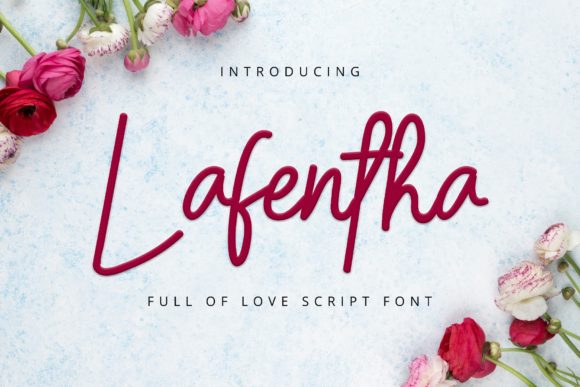
Lafentha: Romantic, Sweet, and Surprisingly Versatile
Imagine a font that feels like handwritten love notes passed across a café table—soft curves, gentle swells, and just the right amount of playful bounce. That’s Lafentha: a script font that balances romantic charm with everyday approachability. It’s not overly formal, never stiff—and it certainly doesn’t take itself too seriously. Yet beneath its casual sweetness lies real design utility. Whether you’re printing wedding invites at home or branding a small-batch candle shop, Lafentha fits in without fading into the background.
What Makes Lafentha Feel So… Human?
Unlike many script fonts that rely on rigid calligraphic rules or dramatic flourishes, Lafentha was crafted with warmth and rhythm in mind. Its letterforms flow naturally—think of how your own handwriting softens when you’re writing to someone you care about. Uppercase letters have subtle lift; lowercase “a”, “g”, and “y” include friendly, open counters. There’s no forced contrast between thick and thin strokes—just smooth, consistent weight that reads clearly at both small and large sizes.
This human quality is why Lafentha works so well across contexts. It doesn’t shout. It leans in. And because it avoids extreme exaggeration, it stays legible—even in body text on digital screens or printed product tags.
Who’s Already Falling for Lafentha?
- Crafters & Hobbyists: From hand-lettered greeting cards to custom embroidery patterns, Lafentha adds personality without demanding perfection. Its forgiving shapes translate beautifully to vinyl cutters, Cricut machines, and printable templates.
- Small Business Owners: A boutique bakery, indie florist, or handmade jewelry line can use Lafentha to signal warmth and authenticity—on packaging labels, social media graphics, or even chalkboard-style storefront signage.
- Wedding Planners & DIY Couples: Invitations, seating charts, and ceremony programs gain instant elegance with Lafentha, especially when paired with clean sans-serif companions (like Montserrat or Inter) for balance.
- Digital Creators: Content creators building brand consistency across Canva, Instagram Stories, or email newsletters find Lafentha refreshingly distinct—yet still accessible enough to avoid alienating viewers.
Where Lafentha Shines (and Where It Might Pause)
Lafentha thrives where tone matters as much as information. It’s ideal for headlines, short quotes, logos, and decorative accents—but less suited for long paragraphs or dense legal disclaimers. Like any script font, readability drops when scaled too small (<12px) or stretched too wide. That’s not a flaw—it’s an invitation to use it intentionally.
Here’s what to keep in mind:
- Pairing matters: Lafentha sings alongside neutral, modern sans-serifs. Try it with Open Sans for web forms, or Lato for presentation slides. Avoid pairing it with other scripts or overly ornate serifs—they’ll compete instead of complement.
- Context is key: A tech startup’s investor pitch deck? Probably not the moment for Lafentha. But their holiday newsletter or internal team appreciation graphic? Absolutely.
- File format flexibility: Available in OTF and TTF formats, Lafentha supports standard ligatures and alternate characters—great for designers who want subtle variation without manual tweaking.
Real Moments, Real Uses
Consider Maya, who runs a tiny ceramics studio from her garage. She used Lafentha to label her first batch of hand-thrown mugs—printing directly onto matte kraft stickers. The font gave her products a handmade, thoughtful feel that customers noticed immediately. “People told me my mugs looked ‘loved before they were even bought,’” she shared.
Then there’s James, a freelance photographer specializing in family portraits. He added Lafentha to his client welcome packet—just for the “Thank You” header and photo session tips section. “It made the whole thing feel personal—not transactional,” he said. “Clients reply faster, and they remember the tone.”
Even educators are quietly adopting Lafentha. One third-grade teacher uses it for classroom reward certificates and reading challenge banners. “Kids recognize it instantly,” she explained. “It feels special—not like something copied from a textbook.”
How to Know If Lafentha Is Right for *Your* Project
Ask yourself three simple questions:
- Is warmth part of the message? If your goal is connection—not authority, urgency, or technical precision—Lafentha aligns naturally.
- Will it be seen up close? Logos, social bios, product tags, and printed keepsakes all benefit from Lafentha’s expressive details. If it’ll appear on a highway billboard or tiny app icon, consider scaling back—or saving it for supporting elements only.
- Do you value ease over edge? Lafentha isn’t trying to shock or disrupt. It’s here to soften, invite, and uplift. If your brand voice leans poetic, nostalgic, or gently joyful, this font likely resonates.
You don’t need design training to sense when Lafentha fits. Try typing your project’s core phrase—“Hand-Poured Soy Candles,” “You’re Invited,” “Just Because”—in Lafentha next to a standard font. Notice how the mood shifts. That quiet shift? That’s the font doing its work.
A Final Thought: Fonts Are Silent Collaborators
We often overlook how deeply typography shapes perception—even before a single word is read. Lafentha doesn’t just look sweet; it helps communicate care, sincerity, and presence. It reminds us that professionalism and playfulness aren’t opposites—they’re partners. In a world saturated with sharp edges and algorithm-driven uniformity, choosing Lafentha is a small but meaningful act of softness.
So whether you're designing your first Etsy banner or refreshing your company’s internal recognition program, give Lafentha space to breathe. Let it hold a headline. Let it sign off a heartfelt note. Let it be the quiet voice behind your most human moments.
Because sometimes, the most powerful design choices aren’t about standing out—they’re about making people feel seen.