Lamor: A Hand-Drawn Uppercase Font with Heart-Adorned Letters
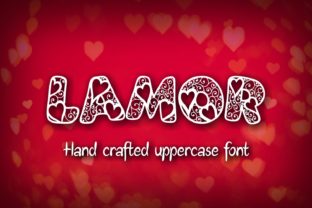
Lamor stands out in the crowded landscape of decorative display fonts—not through technical complexity or stylistic minimalism, but through deliberate, human-centered design. It is a hand-drawn uppercase typeface where each letterform carries one or more stylized hearts as integral decorative elements. These aren’t tacked-on embellishments; they’re woven into the structure—curving around terminals, nested within counters, or forming part of stems and crossbars. That intentional integration gives Lamor both personality and coherence, making it more than just a seasonal novelty.
Design Intent and Visual Identity
Lamor was conceived for warmth, sincerity, and visual softness—qualities often difficult to achieve with all-caps typography. Its hand-drawn nature introduces subtle irregularities: slight variations in stroke weight, organic curves, and gentle asymmetry. This avoids the rigidity common in geometric or monoline capitals while preserving legibility at moderate sizes. The hearts are consistently rendered—not overly detailed or cartoonish—but stylized enough to read instantly as affectionate motifs. They vary in placement and scale per character (e.g., a single heart anchors the top of A, while R features one nestled in its leg), reinforcing visual rhythm without sacrificing recognizability.
Practical Use Cases and Audience Fit
Professionals who regularly produce time-sensitive, emotionally resonant content will find Lamor most valuable when clarity and tone must align tightly. Marketers building Valentine’s Day campaigns—email headers, social banners, limited-edition packaging—can use Lamor to signal intent immediately. Educators designing classroom valentines or bulletin board displays gain a typographic tool that feels personal yet polished. Small business owners launching handmade goods (candles, stationery, confections) benefit from its tactile authenticity: it reads as crafted, not algorithmically generated.
Freelancers and designers working across branding, publishing, or digital content may reach for Lamor selectively—not as a primary brand font, but as a supporting element where emotional resonance matters more than neutrality. For example, a wellness blog’s February self-care guide might use Lamor for section headers alongside a clean sans-serif body font. A wedding planner’s “Love Story” page could feature Lamor for names or dates, adding intimacy without compromising readability.
Performance in Real-World Applications
Lamor performs reliably at sizes 36pt and above in print and high-resolution digital formats. At smaller sizes—below 24pt—the hearts begin to lose definition, and spacing tightens in ways that reduce character distinction. Kerning is well-considered overall, though some pairs (like WV or YO) benefit from manual adjustment in demanding layouts. Its uppercase-only constraint means it works best for short-form text: headlines, logos, labels, quotes, or callouts—not body copy or extended paragraphs.
Color usage affects perception significantly. Lamor gains strength against muted or warm backgrounds (cream, blush, charcoal), where its outlines remain crisp and the hearts retain contrast. On busy textures or low-contrast gradients, detail can recede. In accessibility testing, Lamor meets basic readability thresholds for transient use (e.g., social media graphics viewed for under five seconds), but should not be used for interface labels, form fields, or any UI element requiring sustained reading or screen reader compatibility.
Quality and Technical Execution
The font file itself is well-structured, offering standard OpenType features including basic ligatures and stylistic alternates—though these are minimal by design, preserving Lamor’s focused aesthetic. It renders cleanly across modern browsers and major design applications (Adobe Creative Cloud, Affinity Suite, Figma). No rendering inconsistencies were observed on Windows, macOS, or iOS during testing across multiple versions. File size remains lightweight (~80 KB), posing no performance penalty in web embedding—though given its display-only role, self-hosting via @font-face is recommended over third-party CDNs for full control over loading behavior and fallbacks.
Flexibility Within Constraints
Lamor’s strength lies in its specificity—not versatility. It doesn’t attempt to mimic handwriting, simulate brushwork, or offer lowercase variants. That narrow scope is a feature, not a limitation. Designers who appreciate constraints know that focused tools encourage stronger decisions. Lamor works because it says exactly what it means to say: this is heartfelt, intentional, and celebratory. Pairing it successfully requires restraint. Best companions include neutral sans-serifs (e.g., Inter, Poppins, Montserrat) or low-contrast serifs (e.g., Lora, Crimson Text) that provide contrast without competing for attention.
It resists overuse. A full-page brochure set entirely in Lamor would fatigue readers quickly. But a single headline layered over a soft-focus photo, or a logo lockup where the heart in L doubles as a subtle icon—that’s where Lamor earns its place. Its consistency across characters ensures that even custom wordmarks (e.g., “LOVE”, “FOREVER”, “YOU”) maintain visual harmony without manual redrawing.
Realistic Limitations and Considerations
Lamor is not suited for corporate reports, legal disclaimers, data dashboards, or multilingual projects requiring extended character sets. It includes Latin-1 support only—no Cyrillic, Greek, or Vietnamese diacritics. Users needing accented characters for Spanish, French, or Portuguese will need to supplement with fallback fonts or adjust copy accordingly. Also, while the hearts evoke romance, they don’t automatically convey professionalism in all contexts. A fintech startup’s investor pitch deck, for instance, would risk misalignment using Lamor—even ironically—unless carefully contextualized.
There’s also a subtle expectation management issue: because Lamor looks handmade, audiences may subconsciously associate it with lower production value unless balanced with strong supporting design choices (tight grids, thoughtful whitespace, cohesive color palettes). It rewards intentionality—and punishes hasty application.
Who Benefits Most—and How to Use It Well
Entrepreneurs launching niche products tied to emotion—gift boxes, relationship coaching, artisanal chocolates—gain immediate tonal alignment with Lamor. Bloggers covering lifestyle, mental wellness, or creative entrepreneurship can use it to punctuate thematic moments without seeming clichéd, especially when combined with thoughtful photography or illustration. Educators preparing holiday-themed learning materials find it bridges playfulness and polish, particularly for upper-elementary through adult learners.
For best results, treat Lamor like a signature ingredient: potent in small doses, easily overwhelming in excess. Test it early in your workflow—not as a final flourish, but as a structural decision. Ask: does this headline need to feel warm before it needs to be informative? Does the audience associate hearts with sincerity in this context—or with oversimplification? If the answer leans toward the former, Lamor delivers with quiet confidence.
Its long-term value isn’t in ubiquity, but in reliability for a narrow band of expressive needs. Fonts come and go, but those that solve a specific human communication problem—gently, honestly, and without fuss—tend to endure in practice, if not in trend cycles. Lamor fits that profile. It won’t replace your workhorse sans-serif. But when the moment calls for something tender, unmistakable, and quietly confident, it’s ready.