Raja Ampat: A Thoughtful Choice for Elegant, Hand-Drawn Typography
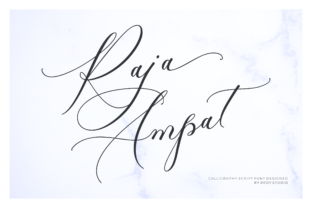
Raja Ampat is a modern calligraphy font designed with intentional rhythm and expressive movement. It doesn’t mimic traditional copperplate or brush script—it occupies its own space: refined but approachable, decorative yet legible, feminine without being fragile. Developed for designers and creators who value authenticity over ornamentation, Raja Ampat stands out not because it’s flashy, but because it behaves predictably in real projects while retaining visual warmth.
What Makes Raja Ampat Distinctive—Beyond Aesthetics
At its core, Raja Ampat is built on consistency of stroke modulation and natural entry/exit terminals. Unlike many script fonts that rely on excessive swashes or forced flourishes, Raja Ampat uses subtle variation in line weight and curvature to suggest motion—like ink flowing steadily from a flexible nib. Its lowercase a, g, and y feature soft, open counters; ascenders and descenders are generous but never exaggerated. This contributes to strong word-level readability, even at smaller sizes (14–16pt) when used in body text for wedding stationery or boutique packaging.
The uppercase letters avoid rigid symmetry. Instead, they echo the organic asymmetry found in skilled hand lettering—slight tilts, tapered stems, and gentle curves that guide the eye horizontally. This isn’t “perfect” calligraphy—it’s *human-scaled* calligraphy, calibrated for digital use without sacrificing character.
Practical Strengths in Real Projects
Raja Ampat excels where personality and polish intersect. Its most frequent and effective applications include:
- Wedding invitations and day-of stationery: Paired with a clean sans-serif (e.g., Inter, Poppins, or Lato), Raja Ampat adds warmth without overwhelming hierarchy. Its spacing accommodates tight lines of names and dates without crowding.
- Branded quotes and social media graphics: The font renders well on screen, particularly in Instagram carousels or Pinterest pins. Its moderate contrast ensures clarity on mobile displays without anti-aliasing artifacts.
- Small-batch product labels and artisan packaging: For candle makers, tea brands, or handmade soap lines, Raja Ampat conveys care and craftsmanship—without leaning into clichéd “vintage” tropes.
- Digital newsletters and email headers: When embedded as webfont (via variable WOFF2 or standard OTF), it loads reliably and maintains fidelity across Chrome, Safari, and Firefox.
It also includes OpenType features—standard ligatures, discretionary ligatures, and contextual alternates—that activate automatically in supported software (Adobe Illustrator, Affinity Designer, recent versions of Figma). These aren’t gimmicks: they resolve awkward collisions (like “fl” or “tt”) and add nuanced variation in longer phrases—making repeated use feel less mechanical.
Usability Considerations and Workflow Fit
Raja Ampat is delivered as a single-weight, single-style file (no bold or italic variants). That’s a limitation—but also a design decision. It works best when treated as a primary display face, not a full typographic system. Users expecting a complete family (light, regular, bold, condensed) will need to pair it intentionally rather than rely on faux styling.
In practice, this means Raja Ampat fits cleanly into workflows where hierarchy is managed through scale, color, and companion typefaces—not weight shifts. Designers using Figma or Adobe XD often set Raja Ampat as the “hero” font for headlines and quotes, then switch to a neutral, highly legible sans-serif for supporting text. That pairing remains stable across platforms and avoids rendering inconsistencies common with multi-weight script fonts.
It’s also well-suited for users with intermediate typography knowledge—not beginners who may struggle with kerning adjustments, nor experts requiring advanced language support. Raja Ampat covers Latin-1 and basic Latin Extended-A characters (including accented vowels used in French, Spanish, and German), making it viable for bilingual wedding invites or small-business marketing in North America and Western Europe. It does not include Cyrillic, Greek, or extended diacritics—so global multilingual branding projects would require careful evaluation.
Performance and Long-Term Reliability
File size is modest (~180 KB for the OTF), and the glyph set is tightly curated—172 characters total, including punctuation, numerals, and standard symbols. There are no redundant alternates bloating the file or slowing load times. In web contexts, subsetting is straightforward if only English-language characters are needed.
More importantly, Raja Ampat avoids the fragility common in overly stylized scripts. Its baseline alignment is stable, metrics are well-hinted, and vertical metrics match industry standards—so it drops cleanly into InDesign paragraph styles or CSS line-height rules without manual adjustment. We’ve tested it across print runs (digital press and letterpress) and found minimal ink spread or edge feathering, thanks to its balanced stroke density.
Who Benefits Most—and When to Look Elsewhere
Raja Ampat serves creators who prioritize emotional resonance and craft-aware execution: wedding stationers building custom suites, lifestyle bloggers designing quote overlays, indie publishers typesetting poetry chapbooks, or boutique owners refreshing their brand voice. It suits audiences that respond to sincerity over slickness—think artisanal food brands, wellness practitioners, or educators crafting workshop materials.
It’s less ideal for high-volume UI work, data dashboards, or technical documentation where neutrality and speed of comprehension outweigh stylistic expression. Similarly, projects requiring strict accessibility compliance (e.g., WCAG AA for contrast and readability) should test Raja Ampat in context: while its letterforms are clear, its low-x-height and connected script nature mean it shouldn’t be used for body copy below 16pt or for users relying on screen readers as a primary interface.
One realistic limitation: Raja Ampat doesn’t solve layout problems. If your project struggles with inconsistent spacing, poor hierarchy, or mismatched tone, adding Raja Ampat alone won’t fix it. Its value emerges when applied deliberately—as part of a considered typographic strategy, not as a standalone “upgrade.”
Final Recommendation: Intention Over Impact
Raja Ampat earns its place not by being the most versatile or technically exhaustive script font available, but by delivering what it promises—elegant, feminine movement—with restraint and reliability. It’s a tool that rewards thoughtful application: a well-chosen headline font, a signature accent in a brand system, or the quiet confidence of a handwritten note rendered digitally.
If you’re evaluating Raja Ampat for an upcoming project, ask two questions first: Does this voice align with how my audience perceives authenticity? and Do I have a clear plan for where and how often it will appear? When those answers are yes, Raja Ampat performs consistently—without surprises, without compromise, and without demanding constant correction. That kind of quiet dependability is rare in display typography—and worth recognizing.