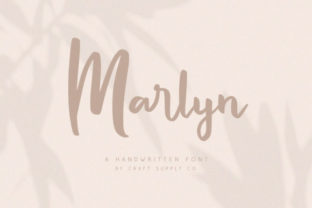
Marlyn: A Handwritten Font That Earns Its Place in Strategic Design
Marlyn isn’t just another decorative script—it’s a deliberately expressive handwritten font with confident swashes, organic rhythm, and subtle contrast that carries weight without sacrificing warmth. Its swirly charm isn’t ornamental for ornament’s sake; it’s functional nuance, calibrated to signal approachability, authenticity, and human-centered intention. For professionals who rely on visual language to shape perception—whether launching a boutique brand, designing course materials, crafting client proposals, or refining a newsletter’s voice—Marlyn offers more than aesthetic appeal. It delivers strategic leverage when used with clarity of purpose.
Why Marlyn Fits Real-World Goals—Not Just Aesthetic Preferences
Design decisions compound over time. Choosing Marlyn isn’t about “liking the look”—it’s about aligning typographic tone with measurable outcomes. When your goal is to soften formality without losing credibility—say, in an educator’s workshop handout, a therapist’s welcome email, or a sustainable product’s packaging—Marlyn bridges the gap between professional and personal. Its letterforms retain legibility at medium sizes while inviting closer attention, supporting retention in learning materials or storytelling-driven marketing.
Unlike overly stylized scripts that sacrifice function for flair, Marlyn maintains consistent x-height and open counters. That means it performs well across mediums: on screen (at 18–24px body size), in print (on textured paper or kraft labels), and even in motion graphics where subtle animation enhances its natural flow. This reliability makes it a practical choice—not just a momentary trend.
Where Marlyn Adds Value—And Where It Doesn’t
Strategic use starts with context. Marlyn excels in situations where you’re intentionally prioritizing emotional resonance alongside clarity:
- Brand identity systems that center empathy—think wellness studios, independent bookshops, or artisanal food brands—where customers seek connection, not corporate polish;
- Educational content, especially for adult learners or creative workshops, where warmth lowers cognitive load and encourages engagement;
- Customer-facing touchpoints like handwritten-style thank-you notes, limited-edition packaging, or personalized onboarding emails that reinforce human-scale service;
- Creative direction for campaigns built around storytelling, nostalgia, or craft—where typography becomes part of the narrative, not just its container.
It’s less effective—and potentially counterproductive—in contexts demanding neutrality, speed of comprehension, or broad accessibility: legal disclaimers, data dashboards, multilingual interfaces, or dense technical documentation. Marlyn’s personality is strong. Using it there dilutes authority rather than strengthens it.
How to Approach Marlyn With Intention—Not Impulse
Before dropping Marlyn into a layout, ask three questions:
- What emotion or impression must this communication reliably evoke? If the answer is “trust through consistency” or “clarity above all,” Marlyn may not be the optimal tool—even if it looks beautiful.
- Who reads this—and under what conditions? A freelance designer sending a PDF proposal to a Fortune 500 procurement team benefits from restraint. The same designer using Marlyn for their own portfolio site? That’s alignment.
- Does Marlyn support—or compete with—the hierarchy and message? Pair it with a clean, neutral sans-serif (like Inter, Lato, or Source Sans) for body text. Let Marlyn headline, label, or accent—not dominate.
This isn’t about rules for rule’s sake. It’s about reducing friction between intent and interpretation. Every design choice either sharpens focus or blurs it. Marlyn sharpens when it’s the right voice for the moment—not every moment.
Risks of Using Marlyn Without Strategy
Without grounding in goals, Marlyn can unintentionally signal inconsistency, informality where rigor is expected, or even exclusivity. Consider a university continuing education department using Marlyn across all course descriptions: students may perceive reduced academic weight, especially alongside traditional serif or sans-serif typography elsewhere on the site. Or a financial advisor embedding Marlyn in retirement planning guides—readers might subconsciously associate the whimsy with lack of precision.
These aren’t flaws in Marlyn. They’re misalignments between typographic character and communicative need. Fonts don’t carry meaning in isolation—they gain meaning through relationship: to audience, to medium, to adjacent elements, and to the broader system they inhabit. Marlyn gains strength when its use is deliberate, bounded, and repeatable—not random or reactive.
Practical Planning Tips for Long-Term Use
If you’re integrating Marlyn into a brand or workflow, treat it like a voice—not a decoration:
- Define usage boundaries early. Specify exact applications: “Marlyn is used only for H1s on landing pages, section headers in lead magnets, and signature lines in email templates.” Avoid vague guidelines like “use when it feels right.”
- Test legibility across devices and contexts. Render Marlyn at 16px on mobile Safari, then at 20pt on matte-finish business cards. Does spacing hold? Do swashes collide or become muddy? Adjust tracking manually if needed—don’t assume defaults suffice.
- Document pairings and fallbacks. Note which sans-serif supports Marlyn best in your use cases—and what happens if web font loading fails. A well-chosen system font fallback preserves tone even when Marlyn doesn’t render.
- Revisit usage quarterly. As your audience evolves or your offerings expand, reassess whether Marlyn still serves your current positioning. Growth often demands refinement—not abandonment, but recalibration.
Marlyn in Action: Realistic Examples
A small-batch candle maker uses Marlyn exclusively for product name tags and seasonal campaign headlines—never for ingredient lists or safety instructions. Customers associate the font with the brand’s handmade ethos, while regulatory text remains clear and scannable in Open Sans.
An instructional designer building a self-paced leadership course applies Marlyn to module titles and reflection prompts—creating psychological “entry points” that feel inviting. Core concepts and definitions appear in a highly legible, low-contrast sans-serif. The result? Learners report higher completion rates and describe the experience as “thoughtful, not overwhelming.”
A freelance copywriter includes Marlyn in her email signature and proposal cover page—but switches to a crisp, modern sans for pricing tables and scope outlines. Clients consistently comment on how “human” and “confident” the materials feel—without questioning expertise or detail orientation.
Final Thought: Marlyn Is a Tool for Clarity, Not Concealment
Typography that works well doesn’t draw attention to itself—it draws attention to the idea. Marlyn earns its place when it helps people feel seen, understood, or gently guided—not when it distracts, confuses, or overpromises. Its swirly charm is most powerful when anchored in discipline: clear goals, defined audiences, and thoughtful constraints.
That’s how fonts become assets—not just assets in a library, but active contributors to trust, recall, and action. Marlyn won’t fix unclear messaging or compensate for weak strategy. But in the hands of someone who plans before placing, who edits before exporting, and who chooses meaning over momentum—it becomes quietly indispensable.