Richardine Script: A Strategic Choice for Bold, Clear Communication
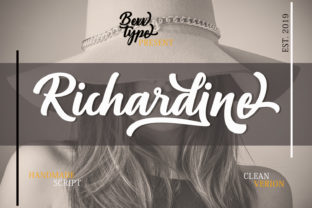
Richardine Script isn’t just another retro font—it’s a deliberate typographic tool built for impact without compromise. With its bold strokes, clean terminals, and confident rhythm, it delivers visual authority at a glance. Unlike decorative scripts that sacrifice legibility for flair, Richardine Script balances personality with precision. That duality makes it unusually versatile—not as a default, but as a considered choice when clarity, memorability, and stylistic cohesion matter.
Why Context Matters More Than Aesthetics
Choosing Richardine Script isn’t about chasing a trend. It’s about aligning typography with intent. When your goal is to anchor a brand identity—say, a local bakery emphasizing handcrafted quality or a boutique fitness studio projecting energy and approachability—Richardine Script communicates confidence without shouting. Its retro roots evoke familiarity and warmth, while its structural discipline prevents visual noise. That combination supports trust-building: customers recognize competence and consistency before they read a single word.
But context determines whether that alignment succeeds. Using Richardine Script on a complex data dashboard or in dense body copy undermines its strengths. Its value lies in controlled application—where space, hierarchy, and purpose are intentional. Think of it less like paint and more like a signature: effective only when placed deliberately, not applied indiscriminately.
Where Richardine Script Delivers Measurable Value
Strategic use of Richardine Script shows up most clearly in five high-leverage areas:
- Branding & Positioning: When launching a new product line or repositioning an existing one, Richardine Script helps signal differentiation. A skincare brand shifting from clinical to holistic might adopt it for logo lockups and packaging headers—conveying craftsmanship and authenticity without leaning into clichéd “hand-drawn” tropes.
- Signage & Environmental Graphics: Its bold weight and open letterforms hold up at distance and in varied lighting. For storefronts, event banners, or trade show booths, Richardine Script ensures messaging remains legible and distinctive—even under time pressure or ambient distraction.
- Merchandise & Packaging: On t-shirts, tote bags, or product labels, it avoids the fatigue of overused sans-serifs or the fragility of ultra-thin scripts. It scales well across fabric textures and print processes, reducing production revisions and color-matching complications.
- Digital Headlines & Social Assets: In email subject lines, Instagram story text overlays, or landing page hero sections, Richardine Script creates immediate visual contrast against neutral backgrounds. That contrast increases dwell time and reinforces message recall—especially when paired with concise, benefit-driven copy.
- Educational & Creative Materials: Educators designing workshop handouts or freelancers building pitch decks find Richardine Script useful for section headers and key takeaways. Its clarity supports cognitive processing—readers grasp structure faster, which improves retention and reduces scrolling friction.
Planning Your Use: Three Practical Filters
Before committing to Richardine Script, run each application through these filters:
- Legibility at Scale: Will this be viewed on a mobile screen at 24px? On a billboard at 10 feet? Test early. Richardine Script shines at medium-to-large sizes (32px and up digitally; 1.5 inches and larger physically). Below that, its character details begin to compress—potentially sacrificing readability for style.
- Contrast & Background Compatibility: It thrives against flat, solid backgrounds—white, charcoal, deep navy, matte black. Avoid busy textures, gradients, or low-contrast combinations (e.g., light gray on off-white). If your layout demands complexity, reserve Richardine Script for primary headlines only—and pair it with a highly legible, neutral secondary typeface for supporting text.
- Brand Voice Consistency: Does it reflect how you want people to feel when they encounter your work? Richardine Script carries warmth and intention—but not playfulness or austerity. If your voice is technical, minimalist, or deeply formal, it may clash. If it’s human-centered, confident, and grounded, it often reinforces rather than competes.
Risks of Unintentional Use
Using Richardine Script without strategic framing can dilute rather than strengthen communication. Common missteps include:
- Overuse across touchpoints: Applying it to every headline, button label, and caption flattens hierarchy. Without variation, nothing stands out—and attention collapses into uniformity.
- Mismatched pairing: Combining it with overly ornate or clashing fonts (e.g., heavy slab serifs or chaotic display faces) creates visual tension that distracts from meaning. It pairs best with restrained, functional typefaces—think Inter, Lato, or Source Sans Pro—for balance and breathing room.
- Ignoring accessibility: While highly legible for most readers, Richardine Script’s connected forms and moderate stroke contrast mean it shouldn’t serve as UI text or body copy in digital products. Always verify WCAG contrast ratios for foreground/background pairings—and never rely on it alone for critical information like pricing, warnings, or instructions.
Long-Term Brand Considerations
Typography choices compound over time. Richardine Script’s retro-modern character gives it staying power—but only if used with restraint and foresight. Brands that build equity around it tend to do so by anchoring it to specific, repeatable applications: a consistent logo treatment, standardized signage guidelines, or a defined set of marketing templates. That repetition builds recognition without requiring explanation.
It also adapts well to evolution. A startup using Richardine Script for early-stage branding can retain it through growth—shifting from handwritten-feel accents to bolder, more refined implementations as their audience matures. The font itself doesn’t need reinvention; the strategy around it does.
Getting Started—Without Overcomplicating
You don’t need a full design system to begin using Richardine Script effectively. Start small:
- Apply it to one high-visibility asset—your website’s main headline or your next product launch banner—and measure engagement metrics before and after (time on page, click-through rate, social shares).
- Build a simple usage guide: define exactly where it appears (e.g., “logo only,” “headlines above 48px,” “merchandise front-facing text”) and where it doesn’t (e.g., “never in email body copy,” “never smaller than 28px on web”)
- Test with real users: show two versions of a flyer—one with Richardine Script, one with your current font—and ask which feels more trustworthy, memorable, or aligned with your stated values. Their feedback reveals more than any aesthetic analysis.
Remember: typography isn’t decoration. It’s infrastructure. Richardine Script works because it strengthens that infrastructure—when chosen with purpose, applied with discipline, and evaluated against outcomes. It won’t fix weak messaging or unclear positioning. But in the right hands, at the right moment, it sharpens focus, deepens resonance, and quietly signals that what follows is worth paying attention to.
Final Thought: Intentionality Is the Real Font
The most effective use of Richardine Script happens off-screen—in planning sessions, brand audits, and customer conversations. Ask yourself: What do I want this to accomplish? Who needs to understand it quickly? Where will it live—and how long will it stay there? Answer those questions first. Then let Richardine Script serve the answers—not the other way around.