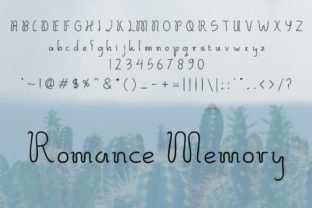
Romance Memory: A Dynamic Script Font
Romance Memory isn’t just another script font—it’s a thoughtful balance of warmth and precision. Designed with authentic hand-drawn rhythm, it carries subtle variation in stroke weight, natural entry/exit terminals, and gentle, organic curves. That means it feels personal without sacrificing legibility or versatility. Whether you’re typing a wedding invitation or designing a boutique product label, Romance Memory adds character while staying grounded in function.
Why Designers Reach for Romance Memory First
Many script fonts fall into one of two traps: overly ornate (hard to read at small sizes) or too uniform (lacking soul). Romance Memory avoids both. Its baseline has gentle undulation—not exaggerated, but enough to suggest movement and breath. Letters connect smoothly where appropriate, yet remain distinct enough for quick scanning. That makes it unusually adaptable across formats and audiences.
It’s also carefully spaced—not tight like calligraphic fonts meant only for display, nor loose like generic handwriting styles. This intentional spacing helps it perform well in both short bursts (like a logo lockup or Instagram story text) and longer passages (such as a heartfelt brand manifesto or illustrated book chapter heading).
Real-World Uses—Beyond the Obvious
Yes, Romance Memory shines on wedding stationery—but its usefulness extends much further:
- Small business branding: A local bakery might use Romance Memory for its “Hand-Mixed Daily” tagline on packaging, pairing it with a clean sans-serif for ingredient lists—creating contrast that feels intentional, not accidental.
- Educational materials: Teachers and course creators use it for section headers in digital workbooks or printable worksheets—adding visual warmth without distracting from content.
- Photography overlays: Wedding and portrait photographers often add subtle quotes or dates directly onto images. Romance Memory’s open letterforms hold up well over textured or busy backgrounds.
- Podcast cover art & social banners: It works at small scale (e.g., 400×400px thumbnails) when used sparingly—think episode title on a minimalist background—not full paragraphs.
- Self-published books: Authors use it for chapter titles or pull quotes in memoirs and creative nonfiction, reinforcing tone without overwhelming readers.
How Different Users Can Adapt It Thoughtfully
Freelancers and designers benefit most by treating Romance Memory as a voice—not just a visual element. Ask: *What feeling does this project need?* If it’s sincerity, softness, or quiet confidence, Romance Memory supports that. But avoid using it where authority, speed, or neutrality is key (e.g., legal disclaimers or technical documentation).
Bloggers and content creators can use it selectively—never for body text, but effectively for featured quotes, email subject lines (in image-based newsletters), or custom Pinterest graphics. One practical tip: export Romance Memory text as vector shapes before adding texture or color overlays—this preserves crisp edges and avoids rendering inconsistencies across devices.
Small business owners should test Romance Memory in context. Try it on mockups of your actual packaging, website banner, or business card. Does it still feel aligned with your audience’s expectations? A luxury skincare line may find it perfect for “Botanical Infusion” on a cream jar; a tech startup launching a productivity app likely won’t. Authenticity starts with fit—not trendiness.
Pairing Romance Memory With Intention
Good pairing isn’t about contrast for contrast’s sake—it’s about supporting hierarchy and guiding attention. Romance Memory pairs best with typefaces that offer structural clarity:
- Sans-serifs with warm proportions—like Poppins, Lato, or Montserrat—balance its fluidity without competing.
- Low-contrast serifs—such as Merriweather or PT Serif—complement its softness while anchoring longer text blocks.
- Avoid high-contrast serifs (e.g., Didot) or ultra-thin sans-serifs unless you’re aiming for deliberate tension—and even then, limit usage to single-line applications.
Color matters too. Romance Memory holds up well in muted palettes—dusty rose, charcoal gray, deep olive—where its subtlety reads as refined rather than faint. In bright contexts (e.g., neon pink on black), consider tightening tracking slightly and increasing stroke contrast via layer effects—just enough to ensure clarity without losing charm.
Keeping It Clear, Consistent, and Audience-Friendly
Clarity begins with restraint. Use Romance Memory for emphasis—not exposition. If your audience includes older adults or people with visual processing preferences, avoid setting it smaller than 24pt in print or 28px on screen for primary headlines. For accessibility, always provide alternative text when Romance Memory appears in image form (e.g., “‘Forever Starts Here’ in Romance Memory font”)
Consistency comes from defining rules early: Will you use it only for headlines? Only in uppercase? Only with specific spacing values? Document those choices—even informally—in your brand guide or design system. That prevents drift across platforms and saves time during revisions.
Originality isn’t about reinventing the font—it’s about how you apply it. Try combining Romance Memory with hand-drawn icons, linen-textured backgrounds, or offset printing techniques. Or use it minimally: a single word centered on a blank page, printed on heavyweight paper. Sometimes the strongest statement is the quietest one.
Getting Started—Practical Next Steps
You don’t need a full redesign to begin. Start small:
- Pick one recurring element—your email signature, blog post title style, or social media highlight cover—and swap in Romance Memory for a two-week trial.
- Test readability by asking three people outside your immediate circle to read a sample aloud or describe the tone they sense.
- Compare side-by-side with your current font. Does Romance Memory clarify intent—or muddy it?
- If it resonates, expand gradually: next, a product label or workshop flyer. Let usage grow from real feedback, not assumption.
Romance Memory rewards intentionality. It doesn’t shout. It invites closer look, slower reading, and thoughtful connection. That makes it especially valuable right now—when audiences are tuning out noise and leaning into authenticity. Whether you’re refining a long-standing brand or launching something new, let Romance Memory serve the message—not the other way around.