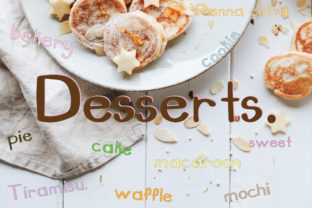
Dessert Font: A Sweet, Playful Script for Thoughtful Design Choices
Dessert is a script font designed with intention—not just aesthetic charm, but functional warmth. It belongs to the broader category of handwritten-style typefaces, yet stands apart through its deliberate balance of legibility and personality. Unlike many decorative scripts that prioritize flourish over function, Dessert maintains consistent letter spacing, open counters, and gentle contrast between thick and thin strokes—making it readable at moderate sizes while retaining its inherent sweetness.
What Makes Dessert Distinctive?
At first glance, Dessert feels familiar—like inked notes passed between friends or labels on artisanal jam jars. But closer inspection reveals thoughtful craftsmanship: subtle variations in stroke weight, soft terminals, and a relaxed rhythm that avoids mechanical repetition. Its lowercase “a,” “g,” and “y” feature friendly, rounded forms without excessive embellishment. Uppercase letters carry presence without dominance, supporting hierarchy without shouting.
This isn’t a font built for headlines alone. Dessert performs well in short-form applications—logos, packaging tags, invitations, social media graphics, and boutique web banners—where tone matters as much as clarity. It doesn’t try to mimic calligraphy tools or emulate historical penmanship; instead, it offers a contemporary interpretation of friendliness, one that feels sincere rather than performative.
Where Dessert Fits Among Script Fonts
Script fonts fall along a spectrum—from highly formal (think copperplate-inspired faces) to casual brush scripts, and from tightly kerned display fonts to more generous, airy designs. Dessert sits comfortably in the middle ground: more structured than a freehand brush font like Quicksand Script or Brusher, yet softer and less rigid than formal scripts such as Great Vibes or Parisienne. That positioning gives it flexibility—but also defines its boundaries.
Compared to ultra-thin, high-contrast scripts, Dessert offers better screen readability at small sizes—especially on mobile devices—because its strokes avoid extreme hairlines that can vanish or blur. Against bolder, chunkier scripts, Dessert retains delicacy without sacrificing presence. It’s not meant for dense body text or long paragraphs, nor does it aim to command attention in high-energy branding (e.g., sports apparel or tech startups). Its strength lies in evoking approachability, care, and quiet confidence.
Strengths and Realistic Use Cases
Dessert excels when the goal is emotional resonance over visual intensity. Consider these practical examples:
- A local bakery updating its website banner: Dessert adds warmth to a headline like “Hand-Mixed Since 2012” without competing with product photography.
- A wedding planner designing digital save-the-dates: Its gentle curves complement soft color palettes and minimalist layouts, reinforcing intimacy without cliché.
- An indie skincare brand labeling reusable cotton pouches: Dessert’s modest scale and organic flow suit tactile, sustainable messaging better than sharp, geometric sans-serifs.
In each case, Dessert supports—not overrides—the message. It works because it respects context: it doesn’t demand attention; it invites engagement. That makes it especially effective in environments where users are already inclined toward calm, considered interaction—such as wellness platforms, craft marketplaces, or boutique hospitality sites.
Tradeoffs to Acknowledge
No script font is universally appropriate, and Dessert is no exception. Its primary limitation is scalability: while legible at 24–36pt in print or high-DPI displays, it begins to lose nuance below 18pt, particularly in UI elements like buttons or navigation links. Its character set is typically standard Latin (A–Z, a–z, 0–9, basic punctuation), so multilingual projects—especially those requiring extended diacritics or non-Latin scripts—may require pairing with a robust companion face.
Also worth noting: Dessert’s tone is inherently warm and personal. That’s an asset in the right setting—but potentially misaligned for brands emphasizing authority, innovation, or technical precision. A financial advisory firm or medical device manufacturer, for example, would likely find Dessert too informal for core communications, even if used sparingly in secondary assets.
When Dessert Is the Right Choice—and When It Isn’t
Dessert fits best when three conditions align:
- The audience values authenticity and human-centered expression—not perfection, but sincerity.
- The application is visually contained: short headlines, logos, labels, or accent typography—not long-form reading or data-heavy interfaces.
- The brand voice leans toward gentle, nurturing, or artisanal qualities, rather than bold, disruptive, or clinical tones.
If your project centers around storytelling, craftsmanship, or emotional connection—and if you’re working within constraints that allow Dessert room to breathe—it’s worth testing alongside alternatives. But if you need versatility across languages, accessibility compliance for low-vision users (where script fonts often struggle with contrast and shape distinction), or typographic flexibility for complex information architecture, Dessert may serve better as an accent than a foundation.
Pairing Dessert Thoughtfully
Because Dessert carries distinct personality, pairing it well matters. It responds gracefully to neutral, humanist sans-serifs—think Inter, Lato, or Work Sans—which provide structural balance without competing. Avoid overly geometric or monoline sans-serifs (e.g., Montserrat or Helvetica Neue) unless intentional contrast is the goal; their rigidity can unintentionally highlight Dessert’s softness as fragility.
For print or editorial use, consider serif companions with open forms and moderate contrast—Merriweather or PT Serif—to maintain warmth while adding gravitas. The key is preserving tonal harmony: Dessert shouldn’t feel like a guest at its own layout. It should feel like part of a coherent visual sentence.
Making Your Decision
Choosing a font like Dessert isn’t about finding the “best” option—it’s about identifying the most honest one for your specific purpose. Ask yourself:
- What feeling do I want users to carry away after seeing this text?
- How much space does this typography have to live in—and how much control do I have over size, weight, and background?
- Does this choice reflect who the brand is, not just who we wish it to appear to be?
Dessert earns its place when those answers point toward kindness, care, and quiet confidence. It won’t solve weak messaging or inconsistent design—but in the right hands, it deepens impact with minimal effort. Like a well-chosen ingredient in baking, its value emerges not in isolation, but in how it elevates everything around it.
If you're evaluating Dessert alongside other script options, test them in real contexts—not just mockups, but actual user-facing touchpoints. See how they behave in email clients, on varying screen sizes, and alongside your existing color palette and imagery. Typography is relational, not absolute. And Dessert, at its best, reminds us that even the smallest design choices can convey something deeply human.