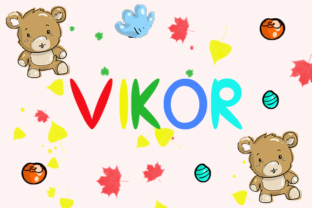
Vikor: A Playful, Distinctive Sans-Serif Font for Creative Projects
When choosing a typeface, many designers and creators instinctively reach for familiar workhorses—clean, neutral fonts that “get the job done.” But what if your project needs more than neutrality? What if it calls for charm, energy, or gentle whimsy—without sacrificing readability or professionalism? That’s where Vikor steps in: a highly original sans-serif font designed to spark joy while staying versatile and grounded.
What Makes Vikor Stand Out?
Vikor isn’t just another rounded sans. It balances structural integrity with expressive personality. Its letterforms feature soft, consistent curves, open counters, and subtly varied stroke endings—details that lend warmth without compromising clarity. Unlike ultra-geometric fonts, Vikor avoids rigid uniformity; instead, it breathes with organic rhythm. The lowercase a, g, and s carry friendly, slightly playful shapes, while capitals maintain confident presence—ideal for headlines that need to stand out *and* feel approachable.
Importantly, Vikor was crafted with real-world legibility in mind. It performs well across sizes—from small captions on printed postcards to large-scale banners viewed from a distance. Its generous x-height and clear spacing ensure text remains inviting, even at smaller point sizes or on lower-resolution screens.
Where Vikor Shines: Practical Applications
Vikor’s unique voice makes it especially effective in contexts where tone matters as much as content. Here are some everyday uses where it consistently elevates the result:
- Children’s media: Covers of picture books, magazine headers, and educational posters benefit from Vikor’s friendly demeanor—it feels inclusive and imaginative, not childish or condescending.
- Printed stationery: Postcards, greeting cards, and invitations gain instant character when set in Vikor. Its warmth encourages connection before a single word is read.
- Digital illustrations & branding: Illustrators often pair Vikor with hand-drawn elements—it complements sketchy lines without competing, creating cohesive visual storytelling.
- Event signage & local business materials: Cafés, boutiques, and community centers use Vikor for window decals, menus, and flyers to convey authenticity and approachability.
- Educational resources: Worksheets, classroom posters, and early-learning apps adopt Vikor for its clear letter shapes—supporting literacy development without visual fatigue.
Who Benefits Most from Using Vikor?
Vikor serves a surprisingly wide range of users—not just graphic designers, but also:
- Small business owners who design their own social graphics or print collateral—and want something memorable yet easy to implement.
- Teachers and educators building classroom materials that feel welcoming and age-appropriate for diverse learners.
- Self-publishing authors, especially those releasing children’s books or illustrated nonfiction, seeking typography that supports narrative tone.
- Nonprofit communicators crafting campaigns around empathy, inclusion, or community engagement—where visual warmth reinforces mission values.
- Students and emerging creatives learning typographic principles through a font that demonstrates how personality and function coexist.
Strengths You Can Rely On
Vikor’s greatest strength lies in its duality: it’s both distinctive and dependable. Unlike novelty fonts that sacrifice utility for flair, Vikor maintains strong typographic fundamentals—consistent spacing, balanced weight distribution, and thoughtful kerning pairs. This means you can use it confidently in mixed layouts: pairing it with a quiet serif for body text, layering it over photography, or setting it solo as a bold statement.
It also scales gracefully. Whether rendered at 12 pt in a PDF booklet or blown up to 8 feet tall on an outdoor banner, Vikor retains its identity and legibility. Its OpenType features—including standard ligatures and alternate characters—offer subtle refinement options without requiring advanced design expertise.
Things to Keep in Mind
Like any tool, Vikor works best when matched thoughtfully to the task. It’s intentionally expressive, so it may feel too lively for contexts demanding strict formality—think legal disclaimers, technical documentation, or corporate annual reports where gravitas is expected. That doesn’t mean it’s “unprofessional”—it simply carries a specific emotional register.
Also worth noting: Vikor’s playful nature comes from its design choices, not from being “cute” or overly decorative. Avoid stretching, skewing, or adding heavy effects (like extreme shadows or outlines), which can dilute its clean integrity. Let the font speak for itself—its charm lives in its subtlety.
Real-World Scenarios: How Vikor Adds Value
Consider a local bookstore launching a summer reading program for kids aged 5–9. They create colorful posters with themed illustrations and need a headline font that feels joyful but not chaotic. Vikor delivers: it anchors the design with structure while amplifying the sense of fun—making the call-to-action (“Join Our Story Hunt!”) feel like an invitation, not an instruction.
Or imagine a wellness coach designing printable habit trackers for clients. She chooses Vikor for section headers (“Breathe Deeply,” “Move Gently,” “Rest Fully”)—its soft geometry mirrors the intention behind each prompt, reinforcing calm and self-compassion visually.
In both cases, Vikor isn’t just “pretty”—it deepens the user experience by aligning visual language with emotional intent.
Evaluating If Vikor Fits Your Project
Ask yourself these three questions before committing:
- Does the tone of my project lean toward warmth, curiosity, or lightheartedness? If yes, Vikor likely enhances rather than distracts.
- Will this be read at a glance—or studied closely? Vikor excels in both, but shines brightest where first impressions matter (e.g., covers, signage, thumbnails).
- Do I need broad language support or extensive stylistic variants (like ultra-bold or condensed)? Vikor currently offers regular and bold weights with Latin-based character sets. For multilingual publishing or complex typographic hierarchies, verify coverage matches your needs.
If you’re still unsure, try a side-by-side test: set the same headline in Vikor and a neutral sans-serif (like Helvetica or Inter). Read them aloud. Which one better reflects the feeling you want your audience to take away? Often, the answer reveals itself quickly—not through logic, but through resonance.
Final Thought: Typography as Tone
Fonts don’t just display words—they shape how those words land. Vikor reminds us that clarity and charm aren’t opposites; they’re collaborators. Whether you're designing a birthday card, launching a new brand, or illustrating a story about kindness, choosing Vikor signals intention: you care not only about what’s said, but how it’s felt.
It’s more than a typeface. It’s a quiet collaborator—one that helps ideas feel human, accessible, and full of possibility.