Capture Font: A Playful Monoline Sans Serif for Confident, Graceful Design
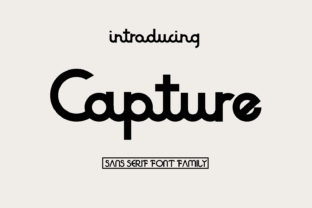
Capture is a monoline sans serif typeface designed with deliberate simplicity and expressive charm. Its defining trait is consistent stroke width—no contrast between thick and thin lines—paired with soft, rounded terminals and subtly organic curves. This gives Capture its signature “playful and cute” character without sacrificing legibility or structural integrity. Unlike many display-oriented fonts that sacrifice function for flair, Capture maintains strong readability at medium sizes and holds up well in both short headlines and moderate-length body text—especially in digital interfaces and modern branding systems.
What Makes Capture Distinct in the Monoline Sans Landscape
Monoline sans serifs have grown increasingly popular for their clean, contemporary feel—but not all share Capture’s balance of warmth and precision. Many lean heavily into geometric rigidity (think perfect circles and uniform corners), which can read as clinical or detached. Others overemphasize quirkiness, sacrificing versatility across contexts. Capture sits deliberately in the middle: its letterforms are carefully calibrated—not overly engineered, not arbitrarily whimsical. The lowercase a and g use friendly single-story forms; the e has a gently tilted crossbar; the t features a subtle upward flick at the terminal. These small decisions add personality without compromising neutrality.
Its spacing and kerning are tuned for even rhythm in mixed-case settings—a practical advantage when pairing with more neutral typefaces or using it across varied layouts. Unlike some monoline fonts optimized solely for display sizes, Capture includes a full range of weights (Light to Bold) and true italics—not slanted romans—which supports typographic hierarchy without visual dissonance.
Where Capture Fits Among Alternatives
When evaluating type options for a new project, designers often weigh monoline sans serifs against humanist sans serifs (like Lato or Open Sans), geometric sans serifs (like Montserrat or Futura), and rounded sans serifs (like Nunito or Quicksand). Each category offers different tradeoffs in tone, flexibility, and technical performance.
- Humanist sans serifs tend to offer superior readability in long-form text and greater warmth through varied stroke contrast and open apertures. They’re often preferred for editorial or informational sites where clarity and trust are paramount. Capture doesn’t compete here—it’s less suited for dense paragraphs or accessibility-critical applications like legal disclosures or medical instructions.
- Geometric sans serifs prioritize structure and consistency, making them ideal for tech brands or minimalist identities. Their strict geometry can feel authoritative but sometimes impersonal. Capture provides a gentler alternative when a brand wants approachability without losing polish—say, for an eco-friendly product line, a wellness app, or a children’s learning platform where friendliness matters, but credibility still does.
- Rounded sans serifs often signal youth, informality, or playfulness—but many rely on exaggerated roundness that limits professional use. Capture avoids this pitfall by keeping rounding subtle and intentional. It reads as warm rather than childish, refined rather than cutesy.
Strengths and Practical Use Cases
Capture excels where tone and personality carry equal weight with function. Its strengths include:
- Brand voice alignment: When a brand’s identity centers on kindness, creativity, or mindful living, Capture conveys those values visually—without needing illustration or color to do the emotional work.
- Digital interface clarity: Its open counters and generous x-height support legibility on screens, especially at 16–20px sizes in UI elements like buttons, cards, or form labels.
- Print versatility: Because it’s well-hinted and includes robust OpenType features (including stylistic alternates and ligatures), Capture performs reliably in PDFs, presentations, and marketing collateral—even at smaller print sizes like business cards or packaging copy.
- Pairing compatibility: It works thoughtfully alongside neutral sans serifs (e.g., Inter or Roboto for body text) or even restrained serifs (like Merriweather or PT Serif) for contrast that feels intentional, not jarring.
Real-world examples include a mental health startup using Capture for its app’s onboarding headlines while pairing it with a highly legible system font for instructions; a sustainable fashion label applying it to hang tags and social media graphics to reinforce its calm, thoughtful ethos; or an independent publishing house selecting it for book covers targeting readers interested in gentle self-development titles.
Limitations and Situations Where Capture May Not Be Ideal
No typeface is universally appropriate—and Capture’s strengths also define its boundaries. It’s not optimized for high-density information environments. In data dashboards, academic journals, or government websites where rapid scanning and absolute neutrality are required, its personality may distract or reduce perceived authority. Similarly, in multilingual projects requiring extensive language support (beyond Latin-based scripts), users should verify glyph coverage—Capture currently supports Western, Central, and部分 Eastern European languages, but lacks extended Cyrillic, Greek, or Asian script sets.
Another consideration is rendering consistency. While modern browsers and operating systems handle Capture well, older Android versions or legacy email clients may substitute fallback fonts unpredictably—particularly if used in HTML email subject lines or inline headings without web font loading safeguards. For mission-critical communications where font fidelity is non-negotiable, testing across environments remains essential.
Decision Factors: Is Capture Right for Your Project?
Choosing a typeface involves more than aesthetics—it’s about alignment with audience expectations, functional requirements, and long-term maintainability. Consider these questions when evaluating Capture:
- What’s the primary message or feeling you want to communicate? If warmth, sincerity, or lighthearted confidence are central—and formality or austerity would undermine your intent—Capture is worth serious consideration.
- How much text will appear in this typeface? It shines in headlines, logos, short quotes, and UI labels. If you plan to set more than ~50 words continuously in Capture, test readability with real users—especially across devices and age groups.
- What’s your technical stack? Does your CMS or design system support variable fonts or custom web font loading? Capture is available in static and variable formats; the latter offers finer control over weight and width, but requires compatible environments.
- Do you need licensing flexibility? Capture is offered under commercial licenses that cover desktop, web, app, and ePub use—but usage rights vary by vendor. Always confirm permissions for your specific deployment context, especially in embedded or SaaS products.
Finally, remember that typography is cumulative. A well-chosen font like Capture enhances clarity and reinforces meaning—but it won’t compensate for unclear messaging, poor layout, or inconsistent visual language. Its value emerges most clearly when integrated intentionally across touchpoints, not applied as a standalone “fix.”
Final Thoughts on Evaluation and Fit
Capture isn’t a replacement for every sans serif in your toolkit—but it fills a distinct and increasingly relevant niche: the need for type that feels both human and polished, playful yet professional. As audiences grow more sensitive to tone—especially in digital spaces where first impressions happen in milliseconds—the ability to signal empathy and authenticity through typography has real impact.
That said, its suitability depends entirely on context. A fintech dashboard aiming for trust through restraint might benefit more from a sturdy humanist sans. A luxury cosmetics brand seeking timeless elegance may lean toward a refined serif. But for a yoga studio launching a new membership platform, a plant-based meal kit service designing its packaging, or a nonprofit building awareness around inclusive education—Capture offers a rare combination: grace, confidence, and style, delivered with quiet assurance.