Pollard: A Thoughtful Script Font for Purposeful Design
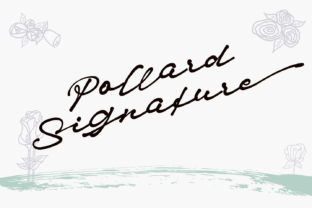
Pollard is a carefully drawn script typeface—not a decorative flourish, but a functional, expressive tool built for clarity and character. Unlike many script fonts that prioritize ornamentation over legibility, Pollard balances fluidity with restraint. Its letterforms are hand-informed but digitally refined, with consistent rhythm, intentional spacing, and subtle variation in stroke weight. It doesn’t shout; it communicates—warmly, confidently, and without pretense.
What Sets Pollard Apart
At its core, Pollard is designed for readability at scale and intimacy at small sizes. Its lowercase ‘a’, ‘g’, and ‘e’ avoid excessive loops or ligatures that often compromise functionality. The uppercase letters maintain presence without dominating—ideal for logotypes where name recognition matters more than visual dominance. Kerning is tight but never cramped; tracking adjustments feel intuitive, not forced. This consistency means less time fine-tuning and more time focusing on message and audience.
The font includes standard and discretionary ligatures, contextual alternates, and a full set of OpenType features—but none feel obligatory. You can use Pollard with default settings and achieve strong results. That’s rare among contemporary scripts, where stylistic sets often require manual intervention to avoid awkward collisions or unintended flourishes.
Real-World Performance and Use Cases
In practice, Pollard excels where authenticity and professionalism intersect. A boutique skincare brand used it for product labels and email headers—readers reported the typography “felt trustworthy, not trendy.” An independent publisher chose Pollard for author bios and chapter openers in a nonfiction title; the script added personality without undermining authority. Educators have applied it to classroom posters and digital handouts, noting improved student engagement compared to generic sans-serif alternatives.
It performs well across media. On screen, its generous x-height and open counters ensure legibility even at 16px in body text applications (though it’s best suited for display use). In print, the contrast between thick and thin strokes translates cleanly—no ink spread or blurring in offset or letterpress runs. Tested at 72–144pt for large-format posters, Pollard holds its shape without appearing brittle or overly delicate.
Strengths in Context
- Flexibility: Works equally well in minimalist layouts and richly layered compositions. Pair it with a neutral sans-serif like Inter, Lato, or Source Sans Pro for balance—or with a low-contrast serif like Literata or IBM Plex Serif for quiet sophistication.
- Consistency: Every weight (Light, Regular, Bold) shares the same underlying structure. Switching weights mid-design doesn’t disrupt rhythm or voice—a practical advantage when building scalable brand systems.
- Reliability: No missing glyphs in common Latin-based languages. Includes full support for Western, Central, and Eastern European characters, plus currency symbols and basic diacritics needed for multilingual publishing.
- Long-term value: Because it avoids fleeting stylistic trends—no exaggerated swashes, no forced irregularity—Pollard ages gracefully. Logos and templates built with it remain relevant years later, reducing redesign cycles.
Who Benefits Most—and When
Pollard suits professionals who need a script that supports, rather than overshadows, their content. Entrepreneurs launching service-based businesses—consulting, coaching, design studios—find it effective for conveying approachability without sacrificing credibility. Marketers building email campaigns or landing pages appreciate how it lifts headlines while keeping CTAs clear and scannable.
Freelancers and agencies use Pollard as a go-to for client-facing deliverables: pitch decks, brand guidelines, social banners. Its restrained elegance helps position work as thoughtful, not flashy. Bloggers and content creators apply it selectively—for quote callouts, section dividers, or newsletter signatures—where a human touch adds warmth without distracting from long-form reading.
Educators and nonprofit communicators benefit from its inclusive tone. It reads as welcoming but not childish, personal but not informal—valuable when addressing diverse audiences across age, background, or literacy level.
Practical Considerations and Limitations
Pollard isn’t intended for dense body copy or data-heavy interfaces. Its script nature makes it unsuitable for tables, forms, or navigation menus where speed and precision matter most. Likewise, it’s not optimized for accessibility in primary UI roles—screen readers won’t misinterpret it, but its visual complexity reduces scan efficiency for users relying on assistive tech.
While highly legible, it does require thoughtful hierarchy. Using Pollard for both headline and subhead in the same layout can flatten visual distinction. Best practice: reserve it for one dominant typographic role per composition—either the logo, the main headline, or the key callout—not all three simultaneously.
Also worth noting: Pollard has no italic variant. Its design philosophy leans into upright confidence rather than slanted emphasis. If your workflow depends heavily on italic differentiation—for citations, definitions, or inline emphasis—you’ll need to pair it with a complementary italic from another family, not rely on synthetic obliques.
Integration Into Your Workflow
Getting started is straightforward. Pollard is available in variable and static font formats, compatible with Figma, Adobe Creative Cloud, and modern web stacks. For web use, self-hosting via @font-face ensures control over loading behavior and performance. A single WOFF2 file (under 80KB) covers the full character set—lighter than many system-ui fallbacks.
When pairing, avoid competing scripts or high-contrast serifs. Instead, lean into contrast of function: let Pollard carry voice and identity, while a clean, highly legible companion handles information density. Test combinations at actual size—not just in mockups—especially for mobile breakpoints, where letter spacing and line height adjustments become critical.
A Final Observation
Good typography doesn’t draw attention to itself—it draws attention to the idea. Pollard succeeds because it’s built on that principle. It doesn’t try to be everything: not a handwriting simulation, not a revival, not a trend-chasing novelty. It’s a considered response to a real need—to express warmth and intention without sacrificing clarity or craft. That makes it durable, adaptable, and quietly effective across contexts where authenticity matters more than ornament.
If your work involves communicating values—trust, care, expertise, individuality—Pollard offers a reliable, human-scaled way to reinforce those messages visually. It won’t solve strategic problems, but it will support them—consistently, respectfully, and well.