Sorinka: A Detailed Evaluation for Crafters and Designers
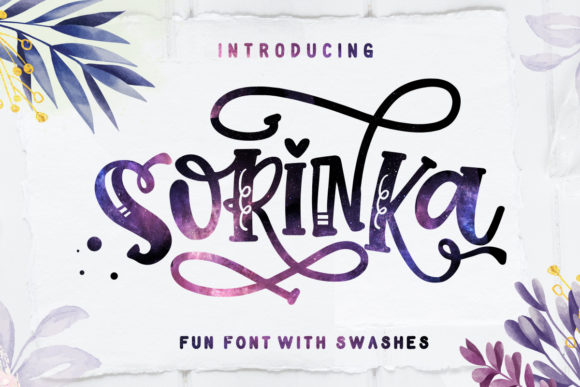
Sorinka is a hand-drawn script typeface designed with expressive, organic strokes and a strong emphasis on natural flow. Unlike many decorative scripts that prioritize uniformity, Sorinka embraces variation—offering an extensive set of ligatures, contextual alternates, stylistic sets, and swash characters. Its design balances readability at moderate sizes with rich visual texture at larger scales, making it especially relevant for craft-focused applications such as greeting cards, packaging labels, wedding stationery, and artisanal branding.
Who Might Consider Sorinka—and Why
Designers and crafters evaluating Sorinka typically fall into two overlapping groups: those working on print-based physical products where typographic nuance matters, and those building distinctive brand identities for small creative businesses. The font’s emphasis on manual authenticity appeals to users seeking alternatives to overused digital scripts or overly rigid calligraphic fonts. Its abundance of alternates allows for subtle customization without requiring advanced OpenType expertise—making it accessible to intermediate users who want more control than basic fonts provide but aren’t fluent in glyph substitution workflows.
Interest often arises during specific project phases: refining a logo lockup, designing a product label with limited space, or preparing a suite of seasonal greeting cards. In these cases, the ability to adjust letter connections, soften transitions, or add terminal flourishes can meaningfully impact perceived craftsmanship and cohesion.
Key Benefits and Practical Advantages
Sorinka’s most notable strength lies in its depth of typographic options. With over 700 glyphs—including discretionary ligatures, initial and final swashes, and multiple forms for common letters like a, g, and s—it supports nuanced composition. This breadth helps avoid repetition in longer text blocks, which is especially useful for short phrases used across multiple touchpoints (e.g., “hand-poured,” “small batch,” or “locally sourced”).
The font includes robust OpenType features that activate automatically in compatible software (e.g., Adobe Illustrator, Affinity Designer, recent versions of InDesign). Contextual alternates adjust character shapes based on neighboring letters, improving rhythm and spacing without manual intervention. Stylistic sets let users toggle between tighter or looser connections, more pronounced swashes, or simplified forms—useful when testing variations for client feedback or production constraints.
Another practical benefit is Sorinka’s consistent baseline alignment and modest x-height, which contribute to stable vertical rhythm in mixed-font layouts. It pairs predictably with clean sans serifs (e.g., Inter, Poppins) or low-contrast serifs (e.g., Lora, Merriweather), supporting hierarchy without visual conflict.
Tradeoffs and Realistic Expectations
While Sorinka offers expressive flexibility, it does require thoughtful application. Its hand-drawn nature means optical consistency varies across glyphs—intentionally so—but this can challenge alignment in tightly spaced settings or when scaling down below 14 pt for body text. It is not intended for long-form reading; even at optimal sizes, extended use may reduce legibility due to stroke modulation and alternate-heavy sequences.
Users should also anticipate a learning curve when leveraging its full feature set. Though automatic ligatures function out-of-the-box, accessing deeper alternates often requires using glyph panels or enabling specific OpenType features manually. This isn’t prohibitive, but it does mean Sorinka rewards familiarity—those unfamiliar with OpenType controls may initially underutilize its capabilities or default to basic character sets.
Additionally, Sorinka’s licensing model follows standard desktop + web tiers. Web use requires proper hosting and format conversion (WOFF2 recommended), and embedding in apps or digital products may require extended licensing—important considerations for designers distributing templates or SaaS tools.
When Sorinka Is a Strong Fit
Sorinka excels in contexts where authenticity, tactility, and attention to detail are central to the message. It performs well for:
- Physical product labeling (e.g., soap bars, tea tins, candle jars) where short, evocative phrases benefit from custom connections and swashes;
- Invitations and paper goods where letterpress or foil-stamping emphasizes texture and variation;
- Branding systems for makers’ markets, local studios, or wellness practices aiming for warmth and human-scale refinement;
- Editorial accents—pull quotes, chapter headings, or section dividers—in printed zines or artisanal magazines.
In each case, the goal isn’t just decoration—it’s reinforcing voice through typography. Sorinka supports that intention by offering tangible evidence of care in construction, both visually and technically.
When Alternatives May Be More Appropriate
For projects prioritizing speed, scalability, or strict accessibility standards, other options may better serve core goals. If a designer needs a script that remains highly legible at small sizes (e.g., 10–12 pt captions or footnotes), Sorinka’s expressive density becomes a liability—not a feature. Similarly, in digital-first contexts where responsive typography must adapt fluidly across devices, its reliance on OpenType features and fixed metrics can complicate implementation.
Users needing multilingual support beyond Latin-based languages (e.g., extended Cyrillic, Greek, or Vietnamese diacritics) should verify Sorinka’s language coverage before committing. While it supports Western and Central European Latin, it does not include comprehensive Eastern European or non-Latin scripts.
Finally, if budget is constrained and only basic script functionality is required—such as a single-weight display face with minimal alternates—more streamlined options (e.g., Playfair Display for contrast-driven elegance or Quicksand for friendly informality) may fulfill the need without added complexity.
Making a Practical Decision
Evaluating Sorinka effectively means aligning its strengths with your project’s operational realities—not just aesthetic preferences. Ask yourself:
- What’s the primary medium? If output is predominantly physical and high-resolution, Sorinka’s detail shines. If it’s screen-dominant or requires frequent resizing, test legibility rigorously before purchase.
- How much time can you invest in refinement? Its value increases with deliberate use of alternates and ligatures. If tight deadlines preclude iterative testing, consider whether simpler scripts would yield comparable results with less overhead.
- Who is the audience? End users who appreciate handmade qualities—such as boutique shoppers or readers of independent publications—respond well to Sorinka’s intentional irregularities. Broader or more utilitarian audiences may find it less immediately legible or approachable.
- What’s the scope of use? A one-off invitation benefits fully from Sorinka’s richness. A scalable design system used across dozens of templates may demand more predictable behavior than Sorinka delivers by default.
Sorinka is neither universally necessary nor universally suitable. Its merit emerges clearly when matched to goals centered on expressive precision—where variation isn’t noise, but narrative. For crafters and designers who treat typography as part of material storytelling, it offers rare depth. For others, its capabilities may exceed functional requirements. Understanding that distinction is the first step toward using it well—or choosing something else with equal intention.