Walking Dream Font: A Practical Evaluation for Designers
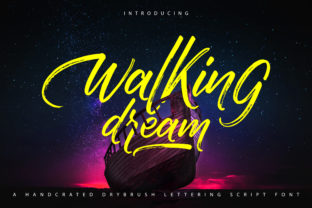
Walking Dream is a dry brush script font characterized by energetic strokes, visible texture, and intentional irregularity. Its letterforms mimic hand-painted calligraphy—slightly uneven baselines, variable stroke weight, and subtle tapering at terminals. Unlike highly polished script fonts, Walking Dream embraces imperfection as part of its identity, delivering a sense of spontaneity and movement without sacrificing legibility at moderate sizes.
Why Designers Consider Walking Dream
Designers often seek Walking Dream when they need a typeface that conveys personality, rhythm, or informal energy—particularly in contexts where polish feels inappropriate or overly corporate. It’s commonly evaluated for branding projects targeting youthful, creative, or lifestyle-oriented audiences: indie apparel labels, artisanal food packaging, music festival posters, editorial features on culture or design, and social media graphics where visual distinction matters.
The font’s dry brush aesthetic also appeals to those prioritizing tactile authenticity. In an era where many digital interfaces favor ultra-clean, geometric sans-serifs, Walking Dream offers contrast—not as novelty, but as deliberate stylistic counterpoint. Its appeal lies less in universal versatility and more in targeted expressive utility.
Key Benefits to Weigh
- Distinctive voice: Walking Dream avoids generic script tropes. Its irregular rhythm and textured strokes help designs stand out in crowded visual environments—especially at display sizes (36pt and above).
- Natural flow: The connected letterforms and organic spacing support readability in short phrases, headlines, and logos when used with appropriate line length and contrast.
- Low technical overhead: As a standard OpenType font file, it installs and behaves predictably in common design applications (Adobe Creative Cloud, Affinity Suite, Figma via plugins). No web font hosting or licensing complexity is required for desktop use.
- Consistent character set: Most commercial versions include uppercase and lowercase letters, numerals, basic punctuation, and standard Latin diacritics—sufficient for English and many Western European languages.
Tradeoffs and Practical Considerations
Walking Dream is not designed for extended reading. Its decorative qualities reduce legibility in body text, long paragraphs, or low-resolution settings. Small sizes (below 24pt), tight tracking, or poor color contrast can quickly erode clarity—especially with characters like “a”, “e”, or “s”, where brush variation may blur distinctions.
It also lacks extensive language support beyond Latin-based scripts. Users working with Greek, Cyrillic, Vietnamese, or Arabic will find coverage limited or absent. Additionally, while the font includes stylistic alternates in some versions, it does not offer optical sizing variants (e.g., caption, subhead, display), meaning designers must manually adjust weight, spacing, or scale depending on context.
Licensing is another practical factor. Walking Dream is typically sold as a commercial font—available through independent foundries or marketplaces like Creative Market or MyFonts. Free versions are rare and often incomplete or outdated; using unlicensed copies risks legal exposure and missing updates or technical support.
When Walking Dream Is a Strong Fit
Walking Dream works well in scenarios where emphasis, brevity, and mood outweigh functional neutrality. Examples include:
- Logo lockups for brands with playful, handmade, or artistic positioning—especially when paired with a neutral sans-serif for supporting text;
- Event posters or album art where typography functions as visual texture rather than pure information;
- Social media banners or Instagram story headers where high-contrast, medium-size text benefits from kinetic energy;
- Print collateral such as greeting cards, zines, or limited-run packaging where tactile quality reinforces brand values.
In these cases, Walking Dream’s strengths align with intent: it supports recognition, evokes tone, and holds up under intentional design constraints—like generous letter spacing, ample white space, and restrained color palettes.
When Alternatives May Be More Appropriate
If your project requires scalability across multiple formats—such as responsive websites, accessible PDFs, or multilingual apps—Walking Dream’s limitations become more consequential. For web use, performance and fallback behavior matter: custom script fonts require careful @font-face implementation, and browser rendering inconsistencies can affect appearance across devices.
Similarly, if your audience includes readers with visual impairments, dyslexia, or low-literacy needs, highly stylized scripts like Walking Dream generally fall outside recommended typographic practices. Legibility guidelines from organizations like the Web Content Accessibility Guidelines (WCAG) emphasize consistent letterform shapes, clear word separation, and adequate x-height—all areas where Walking Dream intentionally departs from convention.
For projects demanding broader language support, variable font capabilities (e.g., adjustable weight or width), or tighter integration with system UIs, alternatives like Bellota, Dancing Script (with caution around size and context), or Playfair Display (for contrast pairing) may offer more flexibility—even if they lack Walking Dream’s specific brush-driven character.
Making an Informed Choice
Evaluating Walking Dream isn’t about whether it’s “good” or “bad”—it’s about alignment. Start by clarifying your core requirements: Is the priority emotional resonance or functional clarity? Will the font appear in one prominent place—or across dozens of touchpoints? Does your audience expect consistency, surprise, or both?
Test early and contextually. Render sample text at actual intended sizes—in the final medium (print, screen, signage). Check contrast ratios. Review how it pairs with secondary typefaces. If possible, gather feedback from people unfamiliar with the project: Can they read it comfortably? Does it evoke the intended impression—or distract from the message?
Also consider long-term maintenance. Will future team members understand why Walking Dream was chosen? Is documentation available for usage guidelines (e.g., minimum size, prohibited combinations)? These aren’t trivial concerns—they affect consistency and scalability over time.
Ultimately, Walking Dream serves a specific niche: expressive, short-form typography where human gesture enhances communication. It excels when used deliberately—not as default, but as decision. For designers weighing options, its value emerges not from broad applicability, but from precise suitability to purpose.