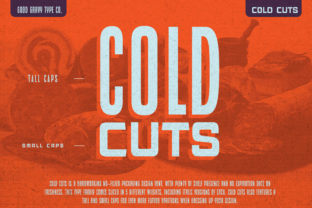
Cold Cuts: A Modern Sans Serif Font for Designers and Developers
Cold Cuts is a contemporary sans serif typeface designed with clarity, versatility, and typographic rigor in mind. It features 10 distinct styles—five weights (Thin, Light, Regular, Medium, Bold) each with matching italics—providing designers with consistent visual hierarchy and expressive range across interfaces, branding systems, editorial layouts, and motion graphics.
Unlike many display-oriented fonts that prioritize stylistic flair over function, Cold Cuts balances structural precision with subtle humanist touches. Its open apertures, even stroke contrast, and generous x-height support readability at small sizes, while its robust weight progression ensures legibility and impact at larger scales. It was developed with digital environments in mind, including variable font compatibility in some versions, though the standard release remains static.
Why Designers Consider Cold Cuts
Designers often explore Cold Cuts when seeking a sans serif that avoids both the neutrality of system fonts and the idiosyncrasies of highly stylized alternatives. Its appeal lies in its measured confidence—not overly austere like Helvetica Neue, nor excessively warm like Proxima Nova. This makes it suitable for projects where tone matters: a tech startup aiming for approachable authority, a cultural institution balancing tradition and modernity, or a publishing platform prioritizing long-form readability without sacrificing visual distinction.
Its 10-style family also addresses practical workflow needs. Rather than layering multiple unrelated fonts to achieve contrast (e.g., pairing a geometric sans with a humanist one), designers can rely on internal variation within Cold Cuts for headings, subheads, body text, captions, and interface labels—all while preserving typographic cohesion.
Benefits of Using Cold Cuts
- Consistent voice across media: The uniform design language across weights and italics helps maintain brand integrity from print collateral to web UIs and video overlays.
- Strong hierarchy without visual noise: Weight differentiation is perceptible but not jarring, supporting clear information architecture without distracting users.
- Good screen performance: Optimized hinting and spacing contribute to stable rendering across browsers and operating systems, especially at 14–18px body sizes.
- Licensing flexibility: Available under standard desktop, web, and app licenses, with options for extended use in enterprise contexts.
Tradeoffs and Practical Considerations
No font solves every problem—and Cold Cuts is no exception. Its strength in neutrality can become a limitation in contexts demanding strong personality or historical resonance. For example, a heritage food brand may find its clean geometry less evocative than a carefully crafted serif or a hand-drawn sans. Similarly, designers working with multilingual content should verify glyph coverage: while Cold Cuts supports Latin-1, Latin Extended-A, and basic Cyrillic, it does not include Greek, Vietnamese, or Arabic scripts. Projects requiring broad international support may need supplemental typefaces or alternative families.
Another consideration is file size. With 10 separate files (or more, if web fonts are subsetted per language), loading strategies matter. For web use, selectively loading only needed weights—especially avoiding unused italics in body text—helps minimize performance impact. Developers should also confirm whether their CMS or framework supports proper font-display fallback behavior to avoid invisible text during load.
When Cold Cuts Is a Strong Fit
Cold Cuts excels in scenarios where clarity, scalability, and restraint are priorities. It works well for:
- Product and SaaS interfaces: Its balanced proportions and high legibility support dense data displays, form fields, and navigation menus without visual fatigue.
- Editorial websites and digital magazines: The Regular and Medium weights serve as readable body text; Bold and Thin provide reliable contrast for headlines and pull quotes.
- Brand identity systems needing adaptability: When a single typeface must function across business cards, signage, presentations, and social assets, Cold Cuts offers predictable results without requiring constant re-tuning.
- Design systems with limited typographic inventory: Teams aiming to reduce font dependencies benefit from its internal variety, reducing the need to license and manage multiple families.
When Alternatives May Be Worth Exploring
Consider other options if your project has specific constraints or goals that Cold Cuts doesn’t address directly. For instance:
- Need for variable font capabilities: If fluid weight or width interpolation is essential—and you require full OpenType Variable Font support—typefaces like Inter, IBM Plex Sans, or Roboto Flex offer broader axis control out of the box.
- Emphasis on accessibility compliance: While Cold Cuts performs well, fonts explicitly designed and tested for WCAG AA/AAA contrast and dyslexia-friendly features—such as Atkinson Hyperlegible or SF Pro Display (with its built-in accessibility tuning)—may be preferable for public sector or education applications.
- Budget or licensing restrictions: Free and open-source alternatives like Work Sans, Manrope, or Lexend deliver comparable functionality and have permissive licenses, making them viable for early-stage startups or nonprofit projects with constrained resources.
- Strong stylistic direction required: If your brand voice leans toward warmth, playfulness, or tradition, fonts like FF Meta, GT Walsheim, or Clash Grotesk might better convey those qualities—even if they offer fewer total styles.
Making an Informed Decision
Evaluating Cold Cuts shouldn’t rely solely on aesthetics or feature lists. Start by auditing your actual usage needs: list the contexts where typography will appear (e.g., mobile app buttons, PDF reports, animated banners), the languages required, and the technical delivery methods (web font hosting, local installation, embedded PDFs). Then test Cold Cuts in those real conditions—not just in mockups, but in browser previews, printed proofs, and on target devices.
Compare it against two or three alternatives using identical copy, layout, and sizing. Pay attention to how each performs in edge cases: hyphenation behavior in narrow columns, line-height consistency across weights, and rendering fidelity on low-DPI screens. Also assess documentation quality—does the foundry provide clear guidance on pairing, spacing recommendations, or known limitations?
Finally, consider longevity. A font’s value increases when it supports iterative design—allowing updates to color, spacing, or weight without overhauling the entire system. Cold Cuts’s disciplined construction supports that kind of evolution, but only if it aligns with your team’s capacity to apply typographic principles consistently.
In summary, Cold Cuts is a capable, well-crafted sans serif suited to practitioners who value reliability, subtlety, and scalable expression. It is not a universal solution—but for many thoughtful, execution-focused projects, it offers a compelling balance of form, function, and flexibility.