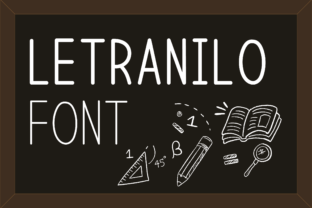
Letranilo: The Modern Sans Serif Font That Combines Clarity, Confidence, and Lightness
Typography is more than just “what text looks like.” It’s the silent ambassador of your message—shaping first impressions, guiding attention, and reinforcing tone before a single word is read. In today’s fast-paced digital landscape—where users scroll in milliseconds and decisions are made in fractions of a second—the right typeface isn’t optional. It’s essential. Enter Letranilo: a contemporary sans serif font designed not only to look smart and clean but to feel incredibly modern and light—delivering any message with confidence and clarity.
What Is Letranilo—and Why Does It Stand Out?
Letranilo is a meticulously crafted, humanist-inspired sans serif typeface. Unlike rigid geometric fonts (think Futura or Avant Garde), or overly neutral system fonts (like Helvetica Neue or Inter), Letranilo balances structural precision with subtle warmth. Its letterforms feature gentle curves, open apertures, and carefully tuned proportions—traits that enhance legibility across screens, print, and even small sizes.
At its core, Letranilo was built for readability without compromise. Its x-height is generous, its stroke contrast is refined—not dramatic, but just enough to create rhythm and distinction. Characters like “a,” “g,” and “e” follow true humanist shapes rather than simplified abstractions, making them instantly familiar to the eye. This familiarity reduces cognitive load—a critical advantage in educational materials, user interfaces, and long-form content.
The Power of “Smart and Clean”: Design Intent Meets Real-World Use
When we say Letranilo “looks smart and clean,” we’re not describing subjective aesthetics alone. We’re pointing to deliberate design choices grounded in typographic science:
- Optimized spacing: Letter and word spacing is calibrated for both screen and print, reducing crowding and improving scannability.
- Consistent rhythm: Even weight distribution across characters prevents visual “stuttering”—a common issue in poorly hinted fonts.
- Multi-weight versatility: From delicate Hairline to commanding Black, Letranilo offers nine weights—each with matching italics—enabling expressive hierarchy without switching type families.
- Language-ready: With full Latin, Vietnamese, and extended Cyrillic support—including localized diacritics and OpenType features like contextual alternates and stylistic sets—it adapts gracefully to global communication needs.
This isn’t just “pretty typography.” It’s functional typography—engineered to serve readers, not just designers.
Why “Feels Incredibly Modern and Light” Matters More Than You Think
“Lightness” in typography goes beyond weight. It’s about perceived density, airiness, and psychological ease. A heavy, tightly spaced font can feel authoritative—but also exhausting. A truly light typeface like Letranilo’s Thin or Light weights doesn’t sacrifice presence; instead, it invites focus by removing visual noise.
Consider these everyday scenarios:
- E-learning platforms: Students reading course modules on tablets benefit from Letranilo’s open counters and generous interlinear spacing—reducing eye strain during prolonged study sessions.
- Startup websites: A fintech or SaaS landing page using Letranilo conveys innovation and trust—not through flashy graphics, but through calm, confident typography that feels both approachable and expert.
- Corporate reports: Annual reviews, sustainability disclosures, or investor decks gain credibility when complex data is presented in a font that feels precise yet humane—never cold or robotic.
- Creative portfolios: Photographers, illustrators, and UX designers use Letranilo to let their work breathe—text recedes just enough to frame visuals without disappearing entirely.
In each case, Letranilo doesn’t shout. It clarifies. And in an age of information overload, clarity is the ultimate differentiator.
Letranilo in Context: Beyond Aesthetics to Experience Design
It’s easy to treat fonts as decorative elements—like wallpaper for text. But Letranilo challenges that assumption. It’s part of a broader shift toward experience-driven typography: where type supports accessibility, emotional resonance, and inclusive communication.
For example, Letranilo’s high legibility at small sizes makes it ideal for mobile-first interfaces—especially for users with mild visual impairments or those navigating under suboptimal lighting. Its consistent stroke width and clear character differentiation (e.g., easily distinguishable “I,” “l,” and “1”) reduce errors in forms, coding environments, and data dashboards.
And unlike many trendy display fonts, Letranilo avoids gimmicks. There are no exaggerated terminals, forced distortions, or arbitrary quirks. Its modernity comes from restraint—not rebellion. That restraint translates into longevity: a brand using Letranilo today won’t need a costly rebrand in three years because the font “feels dated.”
Dispelling Common Misconceptions
Before adopting any new typeface, it helps to clarify what Letranilo isn’t:
- It’s not a “minimalist” font—minimalism implies reduction to the point of abstraction. Letranilo embraces nuance, adding just enough detail to feel alive and intentional.
- It’s not “just another Google Font”—while it shares openness and accessibility goals with free web fonts, Letranilo is a professionally commissioned family with rigorous QA, hinting for legacy systems, and commercial licensing clarity.
- It’s not only for “tech” or “startups”—its warmth and readability make it equally effective in academic publishing, nonprofit storytelling, healthcare communications, and even editorial design for literary magazines.
Practical Integration: How to Use Letranilo Effectively
Getting the most from Letranilo means pairing intention with implementation:
- Pair thoughtfully: Letranilo shines solo—but if combining with a serif, choose one with similar x-height and contrast (e.g., IBM Plex Serif or Charter). Avoid starkly contrasting styles that undermine harmony.
- Leverage optical sizing: Some versions include optical size variants—use Text for body copy (10–16px), Display for headlines (24px+). This ensures crisp rendering at every scale.
- Respect hierarchy: Use weight shifts (e.g., Regular → SemiBold → Bold) instead of size jumps alone. This maintains rhythm while signaling importance.
- Test in real contexts: Preview how Letranilo renders on iOS Safari, Windows Edge, and Android Chrome—not just in design tools. Subtle differences in anti-aliasing matter.
Most importantly: let the font do its job. Don’t over-decorate headlines with shadows or excessive tracking. Letranilo’s strength lies in its quiet authority—amplify that, not obscure it.
A Typeface Built for Today—and Tomorrow
Letranilo reflects a deeper truth about modern communication: the most powerful messages aren’t delivered through complexity, but through clarity. Its smart structure, clean execution, and light, confident presence make it more than a design choice—it’s a strategic asset.
Whether you're a teacher crafting accessible lesson plans, a developer building a dashboard, a marketer launching a campaign, or a student submitting a thesis, Letranilo meets you where you are—and elevates what you say without changing a word.
In a world that rewards speed but demands understanding, Letranilo doesn’t rush. It breathes. It listens. And it delivers—with confidence, and with clarity.