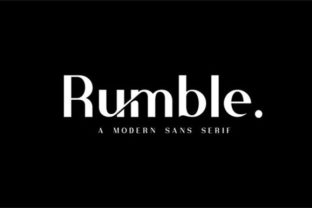
Rumble: An Elegant Sans Serif with Modern Edge
When a font does more than just hold text—it sets tone, signals intention, and quietly strengthens your message—you’ve found something worth building around. Rumble is exactly that kind of typeface: an elegant sans serif designed with precision and presence. It’s not loud or experimental for the sake of it—instead, Rumble balances clean geometry with subtle warmth, giving it both authority and approachability. Its letterforms are confident but never rigid; its spacing is generous without feeling sparse. That balance makes it unusually versatile across real-world applications.
Why Rumble Stands Out in Practice
Many modern sans serifs prioritize neutrality—but Rumble leans into character without sacrificing clarity. Notice how the lowercase a and g use open, friendly shapes; how the uppercase R carries a distinctive leg that’s both structural and expressive; how terminals taper cleanly rather than bluntly cutting off. These details don’t shout—they invite closer reading, build trust, and support retention. For designers and communicators, that means less effort spent convincing people to engage, and more time spent delivering value.
Rumble also performs well across sizes and formats. It holds up crisply in small UI labels, gains sophistication at display sizes (think headlines, posters, or hero banners), and remains legible on screens with variable resolution or contrast. Unlike fonts that rely heavily on stylistic extremes—ultra-thin weights or exaggerated x-heights—Rumble’s range feels intentional and cohesive. Its four core weights (Light, Regular, Medium, Bold) are carefully tuned, not just scaled, so hierarchy feels natural, not forced.
Creative Applications Across Real Projects
What makes Rumble especially useful isn’t just how it looks—but how easily it adapts to different creative goals:
- Brand identity systems: Pair Rumble Regular with a warm, neutral palette for a boutique studio or sustainable brand—its quiet confidence reinforces authenticity without leaning into corporate sterility.
- Digital interfaces: Use Rumble Light for secondary UI text and Rumble Bold for primary actions. Its even color and open counters improve scanability in forms, dashboards, and mobile menus.
- Educational content: Teachers and course creators report better student engagement when using Rumble in slide decks and handouts—its rhythm supports comprehension, especially for longer explanatory passages.
- Publishing & editorial design: In long-form blogs or digital magazines, Rumble’s generous x-height and consistent stroke contrast reduce eye fatigue. Try setting body copy at 18–20px with 1.5 line height for optimal flow.
- Printed materials: From packaging to event programs, Rumble prints with sharp fidelity on both coated and uncoated stocks—no blurring, no unintended weight shifts.
How Different Users Can Make It Work
Freelancers and small studios appreciate Rumble’s flexibility across client work—from minimalist startup websites to vibrant social media assets. Because it doesn’t impose a single “vibe,” it lets the content and imagery lead while still grounding the visual language. One designer uses Rumble Regular for client proposals and switches to Rumble Bold only for section headers—creating consistency without monotony.
Bloggers and educators find Rumble especially effective for readability and tone control. A science communicator uses Rumble Medium for article headings and Rumble Regular for body text—avoiding the coldness of ultra-geometric fonts while maintaining academic credibility. No need for decorative alternatives: Rumble’s quiet strength keeps focus on ideas, not ornament.
Small business owners often lack dedicated design resources—so choosing a font that works well “out of the box” matters. Rumble scales reliably from Instagram story text to printed business cards. One café owner uses Rumble Bold for their chalkboard-style menu board and Rumble Light for ingredient notes—achieving visual hierarchy with just two weights and no extra styling.
Keeping Your Work Clear, Consistent, and Audience-Friendly
Using Rumble effectively isn’t about adding complexity—it’s about thoughtful restraint. Start simple: pick one weight for body text and one for emphasis. Avoid stacking too many font families; Rumble holds its own alongside a single complementary serif (like a warm-textured Garamond or a contemporary Didot) if you need contrast for quotes or captions.
For accessibility, stick to sufficient contrast ratios (at least 4.5:1 for body text), and avoid justified alignment in digital contexts—Rumble’s even spacing shines best with left-aligned, ragged-right settings. On web, serve it as a variable font if possible: it reduces file size and gives you fine-grained control over weight and width without loading multiple files.
Consistency starts with intention. Ask yourself: what role does this text play? Is it guiding, informing, inviting, or affirming? Let that answer determine your weight, size, and spacing—not arbitrary trends. Rumble rewards that kind of clarity. When you align typographic choices with purpose, readers feel the difference—even if they can’t name why.
A Few Practical Starting Points
If you’re exploring Rumble for the first time, try these low-effort, high-impact experiments:
- Replace your current body font in a live webpage or document with Rumble Regular at 16px. Adjust line height to 1.45–1.55 and compare readability after five minutes of reading.
- Create a simple brand style tile: set your logo, a tagline in Rumble Bold, and a short value statement in Rumble Regular. Does it feel grounded but fresh? If yes, you’re on solid ground.
- In a presentation, apply Rumble Bold to all slide titles and Rumble Regular to bullet points—then remove all animations or transitions. See how much stronger the message feels with typography alone.
- Design a social media graphic using only Rumble and one accent color. Focus on whitespace and alignment—not effects or filters. Notice how much visual authority emerges from simplicity.
Rumble doesn’t ask you to reinvent your process. It asks you to refine it—to choose clarity over clutter, intention over impulse, and quiet strength over empty novelty. That’s why it works for a freelance illustrator designing a portfolio site, a nonprofit launching a campaign, or a teacher preparing weekly lesson slides. It meets people where they are—and helps them communicate with more confidence, cohesion, and care.
When your tools support your thinking instead of competing with it, creativity becomes less about overcoming friction and more about following insight. Rumble is built for that. Not as a statement, but as a foundation.